Table of Contents
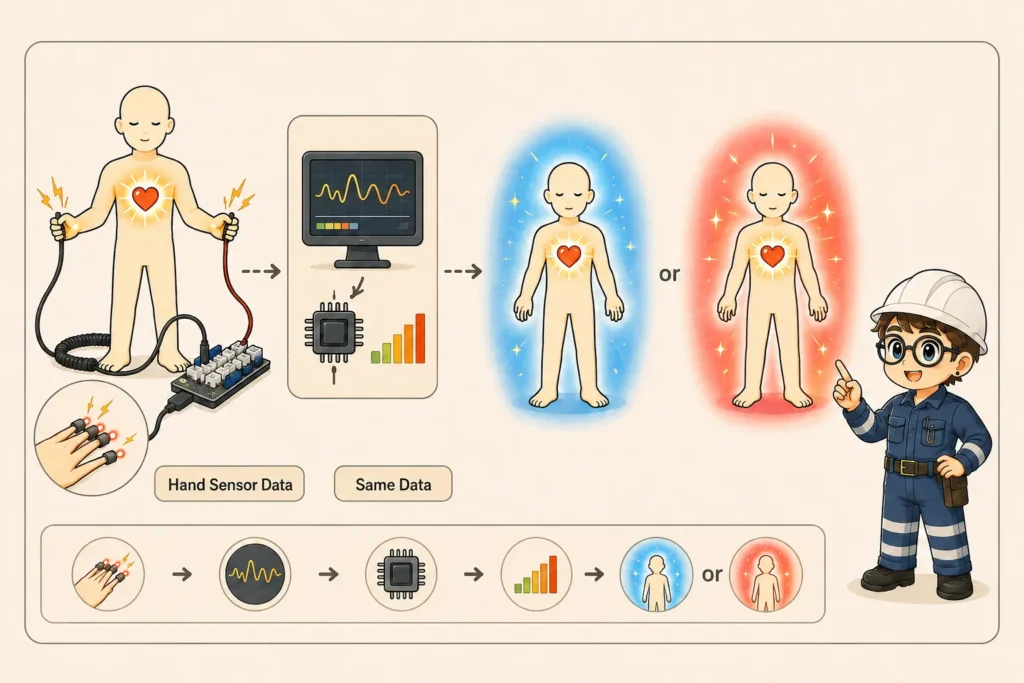
How Does Aura Photography Work? The Short Answer
How does aura photography work? Modern aura photography does not simply point a camera at a person and directly photograph a colored energy field. Based on AuraCamera’s public explanation, the system combines a portrait with a separate hand-sensor input. The sensor signals are processed and mapped into colored visuals, which are then overlaid on the portrait.
The sensor response may be real. The photograph may be real. What still requires separate evidence is whether the assigned colors objectively reveal personality, emotions, chakras, or spiritual energy.
To examine the missing step, I built a transparent GSR and Arduino model, repeated the hand-sensor test three times, replaced the hand with fixed resistors, and replayed the same 300 human sensor readings through two different color mappings.
The central finding: I changed neither the person nor the data. I changed only the color-mapping rule—and the aura changed from blue to red.
▶ Watch the Experiment: Same Data, Two Aura Colors
The video shows the physical setup, repeated electrode-placement tests, the fixed-resistor control, and the synchronized replay of the same 300 sensor readings through blue and red hue mappings.
How Modern Aura Photography Systems Create the Image
The question “How does aura photography work?” becomes easier to answer once the portrait path and the hand-sensor path are separated. The phrase aura photography is used for several different imaging methods. This article focuses on systems such as AuraCamera or AuraCam, where a person sits in front of a camera and places one or both hands on a sensor.
AuraCamera’s public description presents two separate paths: the camera captures the portrait, while proprietary hand-sensor signals are processed and mapped into a colored visualization.
| Source | What It Provides | How It Appears in the Final Image |
|---|---|---|
| Camera | A portrait of the subject | Forms the visible photograph of the person |
| Hand sensor | Proprietary hand-sensor signals | Provides data that are processed and mapped into color |
| Software and imaging system | A color-rendering rule | Combines the colored visualization with the portrait |
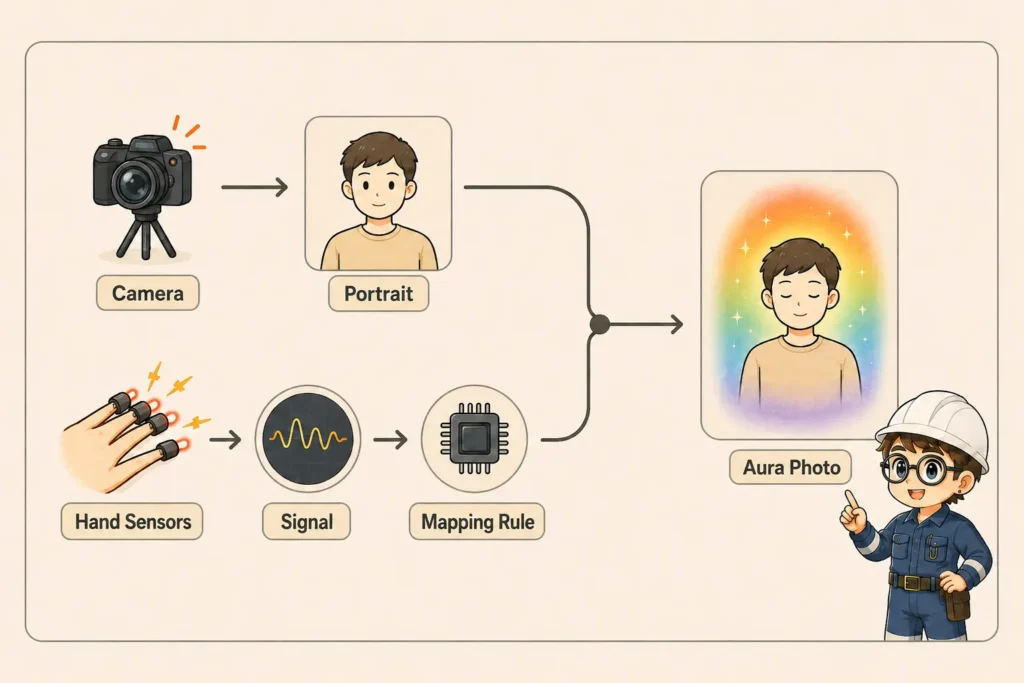
The camera records the person. The colored aura enters the image through a separate processing path. AuraCamera currently describes the result as an artistic rendering for entertainment, generated according to aura traditions.
An earlier U.S. patent for an aura portrait camera described a similar basic architecture: electrical responses from hand electrodes entered a microprocessor, which then controlled colored light used in the photographic process. That patent does not prove that every current device works identically, but it demonstrates that colored light can be added during image formation rather than directly photographed around the body.
What Does an Aura Camera Actually Measure?
This is where many explanations become too confident. Some articles say an aura camera measures temperature, pulse, electromagnetic energy, skin resistance, or “vibrational frequency.” Others reduce the entire system to sweat.
AuraCamera publicly refers to proprietary hand-sensor signals, but it does not publish the complete internal sensor specification. An outside observer therefore should not claim that the commercial device measures only one specific variable without further technical evidence.
For my transparent model, I used a Grove GSR sensor. GSR stands for galvanic skin response, an older term commonly associated with electrodermal activity, or EDA. These systems respond to changes in the electrical properties of the skin.
- Sweat-gland activity
- Skin moisture
- Electrode position
- Contact pressure and contact area
- Skin condition and movement
- Temperature
- Sensor calibration
- Signal filtering and software-selected ranges
A more accurate answer: sweat can affect skin conductance, but a real electrical response does not identify one unique cause or meaning by itself.
The Transparent GSR and Arduino Model I Built
To answer “How does aura photography work?” at the signal level, I made every stage visible: input, sensing, ADC conversion, control logic, and output. I did not build an AuraCam 6000 replica. The commercial system uses proprietary sensors and undisclosed processing. My setup was designed for a narrower purpose: to make the path from physical input to visual output visible at every stage.
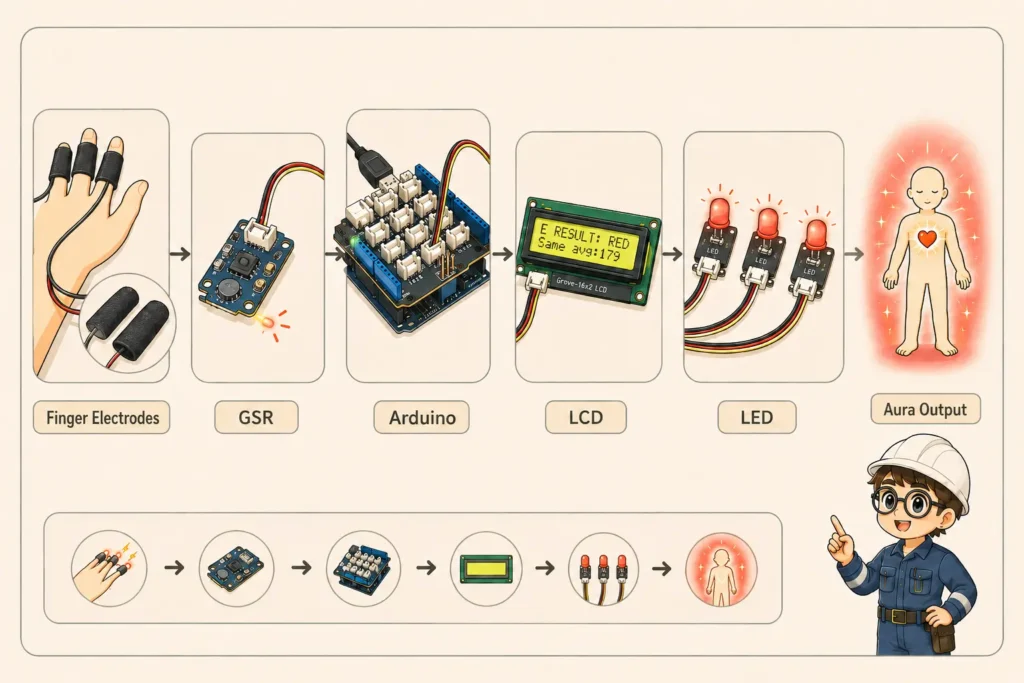
| Stage | What Happens | What It Does Not Automatically Mean |
|---|---|---|
| Finger electrodes | Contact conditions affect the electrical input | The system has identified a personality or emotion |
| GSR sensor | The input is converted into an analog voltage | The voltage is an aura color |
| Arduino ADC | The analog voltage becomes a number from 0 to 1023 | The number is an energy score |
| Control logic | Programmed ranges and rules process the value | The interpretation is natural or inevitable |
| LCD, LEDs, and image step | The model displays numeric and visual outputs | The output validates the meaning assigned to it |
The Arduino values were raw ADC readings. They were not emotion scores, personality scores, chakra values, aura colors, or spiritual-energy measurements. To turn a number into any of those categories, someone must define a rule.
Test 1: The Numbers Changed When I Touched the Electrodes
Before placing the electrodes on my fingers, I adjusted the sensor so that its open-circuit reading remained around 488 to 490. Once I put on the electrodes, the reading dropped significantly.
I then removed and reapplied the electrodes three times using the same general procedure.
| Test | Initial Reading | Reading After About 60 Seconds | Later Stable Range |
|---|---|---|---|
| Test 1 | 350 | 108 | 76–80 |
| Test 2 | 170 | 52 | 30–50 |
| Test 3 | 160 | 100 | 98–105 |
The model was not generating completely disconnected numbers: the electrical input changed when the electrodes touched the body. However, one trial settled in the 70s, another between 30 and 50, and the third close to 100.
Slight differences in electrode placement, contact pressure, skin moisture, contact area, recalibration, or sensor drift could change the raw value.
Supported conclusion: the sensor repeatedly responded to body contact. The test did not show that a falling number meant relaxation, a fixed personality, or one specific aura color.
Why Measuring a Body Response Is Not the Same as Measuring Its Meaning
Polygraph testing provides a useful comparison. A polygraph can record physiological changes such as breathing, heart rate, blood pressure, and skin conductance. Those signals can be real and accurately recorded.
| Stage | What Is Actually Happening |
|---|---|
| A question is asked | The subject receives a stimulus |
| A psychological response occurs | The subject may feel fear, stress, surprise, or another reaction |
| The body changes | Breathing, pulse, sweating, or skin conductance may change |
| The device records signals | Curves and numbers are produced |
| An examiner interprets the signals | Rules and comparisons are used to assign meaning |
A person who lies may show a physiological response. A person who is nervous, frightened, confused, or afraid of being falsely accused may show a similar response. The instrument records the response; it does not directly measure “the lie.”
The same distinction applies to aura photography: a hand-sensor signal does not naturally arrive with a label saying blue, intuitive, healer, blocked chakra, or high vibration.
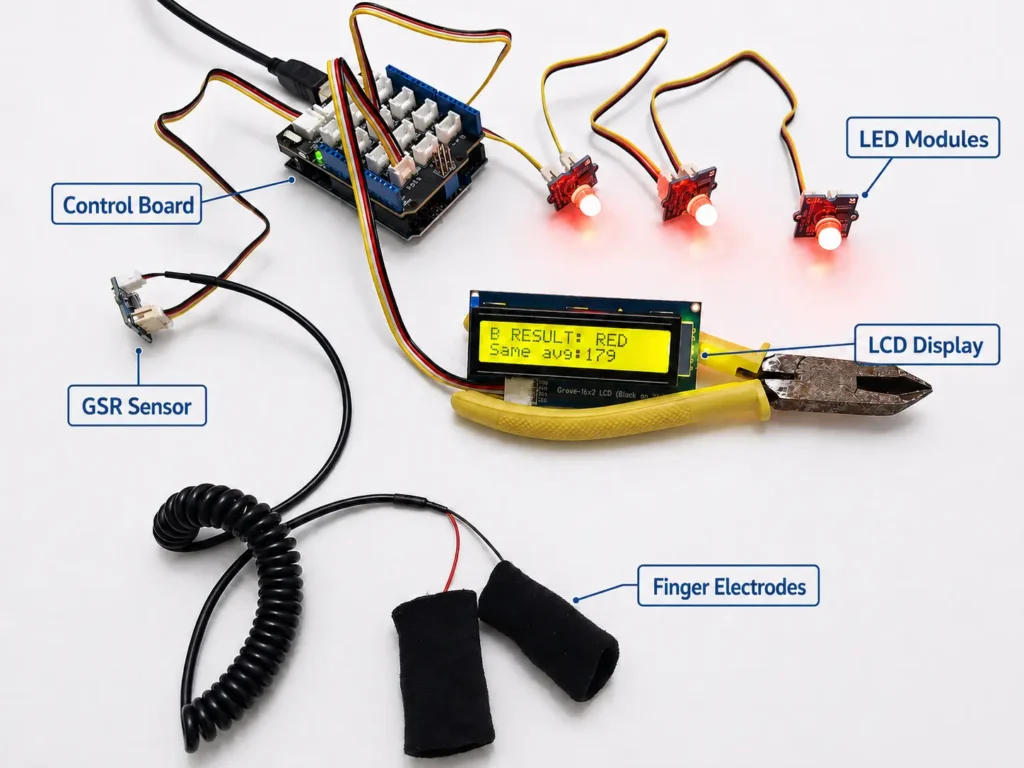
Test 2: Replacing the Hand With Fixed Resistors
After confirming that the model responded to a hand, I asked a different question: does the downstream system know that the input came from a person?
I removed my fingers from the electrodes and allowed the display to return to the open-circuit range of approximately 488 to 490. I then connected a fixed resistor across the two electrode contacts. The resistor had no external power supply; it simply replaced the hand as an electrical condition at the sensor input.
| Input Condition | Controller Response | Downstream Output |
|---|---|---|
| Open electrodes | Returned to approximately 488–490 | Returned to the open-input state |
| Fixed resistor A | Produced a stable reading | LEDs responded according to the program |
| Fixed resistor B | Produced a different stable reading | The downstream output changed |
This does not mean that a resistor has an aura. It demonstrates something much narrower: in the transparent model, the downstream system responds to the electrical input it receives and does not independently know whether the source is a hand or a test component.
The proprietary device may contain additional measurements or input checks that my model does not include.
Test 3: The Same 300 Readings Produced Two Aura Colors
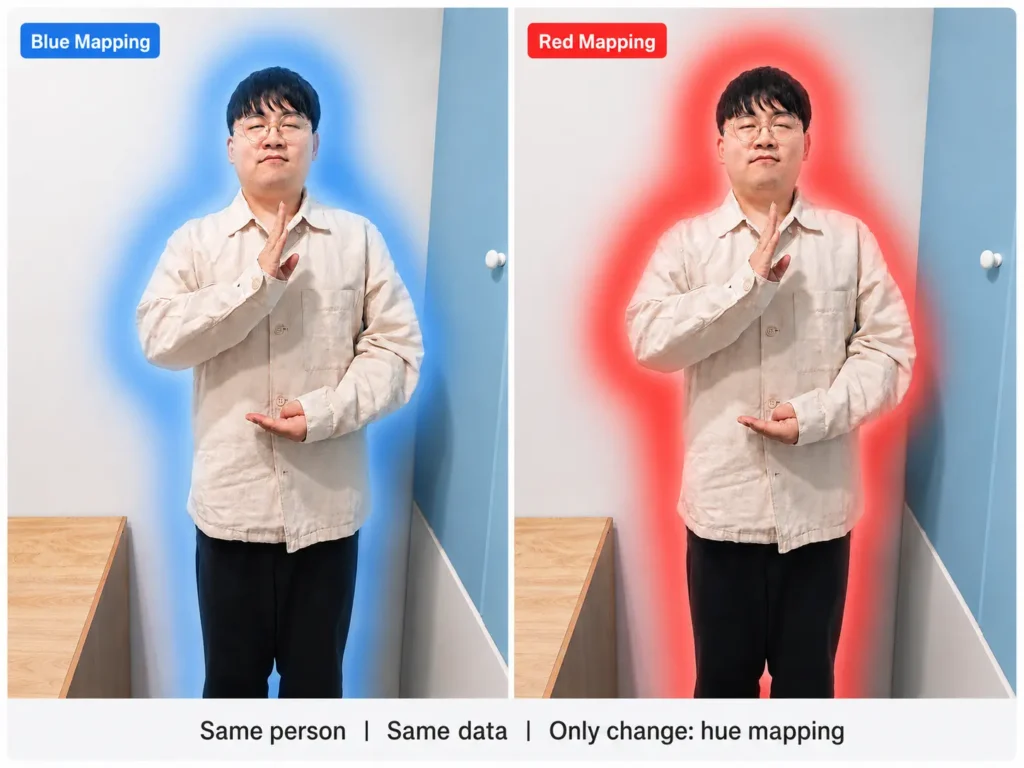
The same-data test provides the clearest experimental answer to “How does aura photography work?” because it isolates the color-mapping rule from changes in the person or sensor data. Repeated body measurements introduce uncertainty. Removing and replacing electrodes can change contact pressure, placement, skin condition, baseline, and signal range.
To isolate the mapping step, I measured only once. After the electrodes reached a reasonably stable condition, I recorded approximately 10 samples per second for 30 seconds.
| Measurement Detail | Value |
|---|---|
| Recording duration | 30 seconds |
| Number of samples | 300 |
| Approximate sampling rate | 10 Hz |
| Minimum | 142 |
| Maximum | 249 |
| Arithmetic mean | 179.1867 |
| LCD rounded average | 179 |
The complete values were saved to a CSV file. I then removed the electrodes. Neither aura output used a second live measurement.
Both outputs replayed the same file. I also fixed the same portrait video, sample order, timing, aura position, aura shape, blur, opacity, and brightness logic.
| Condition | Blue Output | Red Output |
|---|---|---|
| Subject | Same | Same |
| Portrait source | Same file | Same file |
| Sensor dataset | Same 300 samples | Same 300 samples |
| Sample order | Identical | Identical |
| Average | 179 | 179 |
| Brightness logic | Identical | Identical |
| Aura shape and position | Identical | Identical |
| Hue-mapping rule | Blue | Red |
Same person. Same portrait. Same 300 readings. Different hue mapping.
What the Same-Data Experiment Proves—and What It Does Not
| What the Experiment Supports | What the Experiment Does Not Establish |
|---|---|
| Raw sensor data requires a translation rule before it becomes a color | AuraCamera uses my mapping rules |
| The same dataset can produce different visual outputs under different rules | AuraCamera uses only GSR |
| The raw number does not contain a built-in personality or aura label | Commercial operators manually alter customer results |
| Objective interpretations require validation of the mapping | The proprietary algorithm is random or deceptive |
| A real input does not guarantee one inevitable interpretation | No form of spiritual aura could exist anywhere |
The experiment demonstrates a general signal-processing principle: real data still requires a human-designed translation before it becomes a colored aura image.
Evidence boundary: if the result is presented as artistic symbolism, the mapping can be part of the creative experience. If it is presented as an objective measurement of personality, emotion, chakras, or energy, the mapping requires independent validation.
AuraCamera vs. Kirlian Photography vs. Composited Aura Images
These images are often grouped together because they all appear to glow. Their image-formation mechanisms are different.
| Type | Input or Process | How the Visible Glow Is Produced | What It Directly Demonstrates |
|---|---|---|---|
| AuraCamera or AuraCam | Portrait plus hand-sensor signals | Software or imaging logic maps sensor input into color and adds it to the portrait | The system receives an input and generates a colored image |
| Kirlian photography | An object in a high-voltage, high-frequency electric field | The image records corona discharge around the object | A discharge pattern under specific electrical conditions |
| Compositing or multiple exposure | A portrait plus another photographic or digital layer | The glow is added through photography or editing | A visual effect was added to the image |
Kirlian photography can record a real physical phenomenon: corona discharge. The result can change with moisture, surface condition, pressure, contact, voltage, and exposure conditions.
Recording a genuine electrical discharge does not automatically prove that the image represents a spiritual energy field. Likewise, producing a genuine hand-sensor response does not validate the personality or spiritual interpretation assigned to an aura color.
Why Can an Aura Reading Still Feel Accurate?
A person can understand the imaging process and still say, “The reading described me perfectly.” That feeling should not be dismissed, but it also does not prove that the machine identified the person.
You expect a lot from yourself. Even after completing something successfully, you sometimes review it again because you worry that you may have missed an important detail.
Many readers will recognize themselves in that statement, even though everyone received the same sentence.
In 1949, psychologist Bertram Forer gave students what appeared to be individualized personality analyses. The students had actually received the same general description, yet many rated it as highly accurate. This became known as the Forer effect or Barnum effect.
| Factor | How It Can Increase the Feeling of Accuracy | Why It Does Not Validate the Device |
|---|---|---|
| General statements | Broad statements can still feel personally specific | Many people may identify with the same description |
| Color associations | Red, blue, yellow, and other colors create expectations | Associations vary with brightness, saturation, culture, and context |
| Conversation feedback | Facial expressions, pauses, and stories provide additional information | The personalization may come from interaction rather than the sensor |
| Subjective benefit | The experience may help someone reflect or talk about emotions | A helpful experience is not the same as an objective measurement |
A sincere reader may adjust the conversation based on the participant’s responses without realizing how much information is being exchanged. The experience can feel meaningful while the measurement claim remains unproven.
What Evidence Would Show That Aura Colors Measure Personality or Energy?
If aura photography is presented as an objective measurement system, several kinds of evidence would be needed.
| Validation Test | Question It Must Answer | Why It Matters |
|---|---|---|
| Test–retest reliability | Does the same person receive a reasonably similar result under similar conditions? | Separates a stable trait from contact, drift, or measurement variability |
| Cross-device consistency | Do different machines and operators reach similar results? | Shows whether the result generalizes beyond one setup |
| Blind matching | Can readers match results to the correct subjects above chance without identifying information? | Tests whether the result contains person-specific information |
| Inter-rater agreement | Do independent readers reach similar conclusions from the same result? | Tests whether interpretation rules are clear and reproducible |
| Preregistered mapping rules | Were thresholds and interpretations defined before viewing the results? | Reduces after-the-fact interpretation |
| Independent replication | Can researchers without a financial connection reproduce the finding? | Tests whether the effect survives outside the original provider |
These standards are not unusually harsh. Any tool that claims to infer personality, deception, disease, emotion, or mental state from a physiological signal must address reliability and validity.
Is Aura Photography Art or Pseudoscience?
The answer depends heavily on how the service is presented before the customer pays.
| Positioning | Reasonable Boundary | When More Evidence Is Required |
|---|---|---|
| Art, entertainment, or self-reflection | Clearly explains that sensor input is translated through symbolic or proprietary rules and is not a medical or psychological diagnosis | The customer decides whether the experience is meaningful or worth the price |
| Objective personality, chakra, health, or energy test | Claims the machine detects a specific human state | Requires reliability, blind testing, cross-device consistency, and validity evidence |
Sensors, numbers, and printed photographs can create the appearance of scientific authority. The presence of technology does not automatically validate the final claim.
Based on the public documentation and evidence I found, I did not find a reliable, independently validated relationship between aura-photo colors and objective personality traits, chakras, or spiritual-energy states.
The precise conclusion: evidence can support the part of the process that was actually measured and demonstrated. Additional meaning requires additional evidence.
What Aura Photography Teaches Us About Electrical Troubleshooting
Aura photography may seem unrelated to becoming an electrician. The method used to investigate it is closely related to electrical troubleshooting.
- Identify the input: Where does the machine receive information?
- Determine what the sensor measures: Voltage, resistance, temperature, pressure, or something else?
- Follow the signal: How does an analog value reach the controller?
- Inspect the logic: How are ranges, thresholds, and mapping rules used?
- Check the output: Does the visible result support the claim being made?
- Mark the evidence boundary: Which steps are confirmed, and which remain interpretations?
When a motor does not start, replacing the contactor immediately may miss the real problem. The fault may be in the start command, limit switch, overload relay, safety interlock, sensor, control voltage, PLC condition, or output circuit.
Electrical work is not only about connecting wires. It is also about learning how systems receive information, make decisions, and produce results.
This is the skill I want Engineer Tsai to represent: follow the signal, open the black box, and determine what the machine is actually doing.
Continue with Engineer Tsai’s English electrical guides and electrician career resources to learn more about sensors, troubleshooting, electrical fundamentals, and career paths.
FAQ: Aura Cameras, GSR, Sweat, and Kirlian Photography
Is Aura Photography Real?
The portrait and sensor response can be real. The colored aura is generated through a separate processing or mapping step. That does not establish that the camera directly photographed a colored energy field or that the colors objectively reveal personality, chakras, emotions, or spiritual energy.
Does an Aura Camera Only Measure Sweat?
Sweat can influence skin conductance, but readings may also be affected by electrode position, pressure, contact area, skin condition, calibration, movement, temperature, and signal processing. AuraCamera does not publicly disclose its complete proprietary sensor specification.
Can a GSR Sensor Detect Emotions?
A GSR or EDA sensor can detect changes in the electrical properties of the skin. Those changes may occur during emotional arousal, but stress, surprise, heat, movement, contact conditions, and other factors can produce similar changes. One GSR value does not uniquely identify an emotion.
Why Can the Same Person Receive Different Aura Colors?
Possible causes include body conditions, electrode placement, contact pressure, calibration, sensor drift, signal filtering, software thresholds, and the color-mapping rule. Reliable measurement requires repeated testing under controlled conditions.
Is AuraCamera the Same as Kirlian Photography?
No. AuraCamera publicly describes a system that combines a portrait with colors generated from hand-sensor signals. Kirlian photography records corona discharge produced in a high-voltage electric field. Both can create glowing images, but the mechanisms are different.
Do Aura Cameras Photograph Human Energy?
The camera photographs the person. The colored visual is produced through a separate sensor and mapping process. The public evidence does not establish that the final colors are a direct photograph of a scientifically validated human energy field.
Why Do Aura Readings Feel Accurate?
General personality statements, color associations, feedback during conversation, and the Forer effect can all increase the feeling of accuracy. A meaningful experience does not by itself prove that the device measured the claimed trait.
Does This Experiment Prove AuraCamera Is Fake?
No. The experiment does not reproduce the commercial device or reveal its proprietary algorithm. It demonstrates that real sensor data still requires a mapping rule before it becomes a colored visual result.
Conclusion: Real Input Does Not Guarantee One Interpretation
So, how does aura photography work? A portrait and a hand-sensor input are combined through a human-designed mapping process before the final color appears. Aura photography can include real technology: a hand sensor may respond to the body, a controller may receive changing electrical values, and an image-processing system may produce a real photograph.
The unanswered question is what the final colors are qualified to mean.
In my controlled test, the same person, the same portrait, and the same 300 sensor readings produced both a blue and a red aura. The only changed variable was the hue-mapping rule.
Measurement and interpretation are separate stages. Before accepting what a machine says about a person, trace the input, inspect the signal, examine the rule, and ask whether the output supports the claim.
That is not only a way to evaluate aura photography. It is the foundation of electrical troubleshooting.
Further Reading and Watching
- YouTube: What Does an Aura Photo Actually Capture? I Traced the Signal Into the Machine
- YouTube: What Happens After You Flip a Switch?
- Engineer Tsai: English electrical guides and electrician career resources
Sources and Experiment Disclosures
- AuraCamera: AuraCam 6000 operation and artistic-entertainment positioning
- Google Patents: US5132714A, Portrait camera with aura recording means
- Seeed Studio: Grove GSR Sensor documentation
- American Psychological Association: Polygraph principles and limitations
- National Academies: The Polygraph and Lie Detection
- Bertram R. Forer: The Fallacy of Personal Validation
- Systematic review of color–emotion associations
- Pehek, Kyler, and Faust: Image modulation in corona discharge photography
Experiment disclosure: The Grove GSR and Arduino setup in this article is a transparent model of the public signal path, not a replica of AuraCamera’s proprietary hardware. The resistor control applies only to this model. The same-data experiment demonstrates that identical data can produce different visual outputs under different mapping rules; it does not reveal AuraCamera’s algorithm or establish any operator’s intent.
Content disclosure: This article discusses sensing, data processing, image generation, and evidence boundaries. It does not provide medical, psychological, or spiritual diagnosis. An experience presented clearly as art or entertainment can be evaluated as such. Claims of objective personality, health, chakra, or energy measurement require corresponding reliability and validity evidence.
About the Author
Engineer Tsai is a Taiwan-certified interior wiring technician and former MEP site engineer who explains electrical systems through hands-on testing, transparent experiments, and evidence-based troubleshooting.
His work helps beginners understand electricity as a practical career skill—not as a collection of isolated formulas, but as a way to trace signals, diagnose systems, and understand how machines make decisions.