On this page
Table of Contents
If you’re still exploring whether the electrical trade is right for you, start with the full overview: 🔹 “U.S. Electrician Career Guide: Training, Licensing, and Your First 12 Months”
Reading that first will make today’s topic easier to understand.
Electric motor and generator basics can feel scattered when you only meet each motor, generator or VFD in separate textbooks, YouTube videos or US job ads.
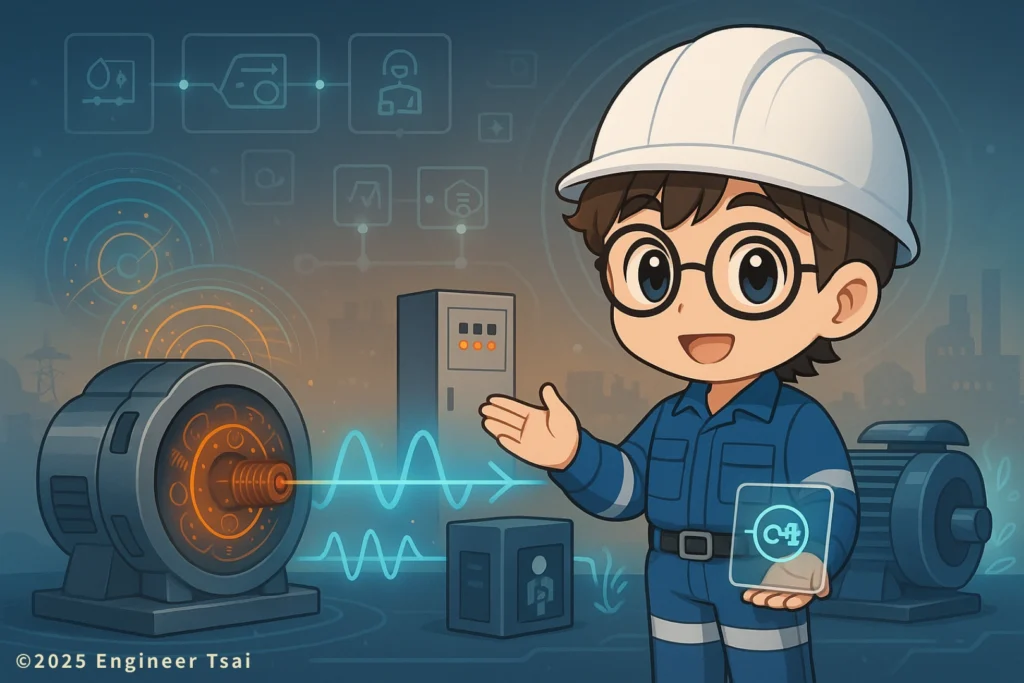
If you’re looking at maintenance or controls roles in US factories, plants or commercial buildings, this guide is your “world map” for the rotating equipment stack:
- How generators actually feed your building,
- Why three-phase induction motors are everywhere,
- Where VFDs sit between the grid and the motor,
- And how all of this shows up in real US job sites and equipment rooms.
If you’re looking at US industrial maintenance, building systems, or automation work, this article is your Track C – Motors × Drives × Generators world map.
While AI is reshaping a lot of office work, every data center, factory, and hospital in the US still needs people who understand how motors, VFDs, and generators keep the place running.
This guide sits on top of a whole learning path: in 0–12 months, you can go from “I kind of remember high school physics” to “I can read the nameplate, trace the power chain, and have real conversations with suppliers and foremen.”
Electric motor and generator basics: your world map for motors, generators and VFDs
Who this article is for
You don’t have to love formulas to keep reading.
This article is for you if:
- You keep seeing words like generator, induction motor, variable frequency drive in US job ads or plant tours, but everything still feels like separate islands instead of one connected system.
- You’re thinking about moving toward industrial maintenance, controls, facilities or MEP work in the US and you want one big picture of how an electric motor and generator system, plus drives, actually fits together on real sites.
- You’re worried about AI reshaping office jobs and want to understand the physical systems – motors, drives, generators – that still need people on site.
If you’re brand-new to the trade:
You don’t need any plant or job site experience yet. Treat this as your world map. Your only job is to see how generators, motors and VFDs fit together – not to calculate every torque–speed curve on day one.
If you’re already on a crew or in a plant:
Use this guide to connect what you see every day – motor rooms, MCCs, generator rooms – into one story, so it’s easier to talk with engineers, foremen and suppliers about what’s really happening in the system.
You don’t need to remember every detail on first read.
What matters is that by the end, you can point at a motor, a generator and a VFD panel and say:
“I roughly know what each one does, how they talk to each other, and what gear shows up around them.”
After reading, you should be able to:
- Explain, in plain language, how electromagnetic induction sits at the core of both generators and motors.
- Describe how DC and AC generators turn motion into electricity.
- Describe how electric motors turn electricity back into motion.
- Understand, at a basic level, what a variable frequency drive (VFD) does and why it shows up next to so many motors.
- Connect all of this to real equipment and materials: motors, wiring, panels, drives, sensors and protection devices you actually see on job sites or in plants.
If you already know this “Track C” path is for you, bookmark this guide as your world map and plan to come back. The zoom-in articles on generators, motors and VFDs linked at the end will be your next stops along the route.
See where every electric motor and generator you meet fits into the same big system.
If you want the deeper math or derivations, I’ll link to separate “zoom-in” articles at the end.
This piece is your world map.
1. The core idea behind everything: electromagnetic induction
Let’s start with the one idea that quietly powers this whole world.
Imagine a simple setup:
- A coil of wire.
- A magnet moving in and out of that coil.
When the magnetic field through the coil is changing, an electric “push” – a voltage – appears in the coil.
No battery, no magic. Just changing magnetic field → induced voltage.
That is electromagnetic induction in one sentence.
In more formal language, Faraday’s law says:
A changing magnetic flux through a loop induces a voltage in that loop.
The important part for us:
- You don’t get anything if nothing changes.
- You get voltage when:
- The magnet moves,
- Or the coil moves,
- Or the magnetic field strength changes,
- Or the area “cut” by the field changes.
Every generator and every induction motor you’ll meet is just this same idea, wrapped in steel, copper and bearings.
If you want a slower, step-by-step tour of this idea, I have a separate article that focuses only on induction and Faraday’s law.
Here, we’ll keep moving toward rotating machines.
2. Generators: turning motion into electricity
Take that coil-and-magnet idea, give it a shaft and bearings, and spin it in a controlled way.
You just walked into generator territory.
At a high level, a generator does this:
Mechanical power in → rotating magnetic field → changing flux in stator windings → electrical power out.
There are many types, but it helps to split them in two big buckets first – especially when you’re trying to see where the electric motor and generator pair fits in a real plant.
2.1 DC generators: older cousins and niche players
Historically, DC generators were used when early power systems and machines wanted direct current.
Inside, you still have:
- A rotating part (rotor or armature) carrying windings in a magnetic field,
- A stationary part (stator) supplying that field or receiving power.
The trick is the commutator – a mechanical switch on the shaft that flips connections at just the right time so the external terminals see a “one-direction” voltage instead of an alternating one.
Today, pure DC generators are less common for utility power. You’re more likely to see:
- Small DC machines in specialized equipment,
- Or DC output created electronically (AC generator + rectifier) instead of mechanically.
For a career changer, it’s enough to know:
- DC machines taught us a lot of early machine theory.
- Most modern large-scale power is AC, not DC.
- The idea – motion plus changing magnetic field → voltage – is exactly the same.
2.2 AC generators (alternators): the workhorses behind the grid
In modern power systems, AC generators, often called alternators, are the main workhorses.
The picture looks like this:
- The stator holds three sets of windings fixed in place.
- The rotor carries a magnetic field and spins inside the stator.
- As the rotor turns:
- The magnetic field “sweeps” across the stator windings.
- The flux through each winding rises and falls in a sinusoidal pattern.
- Each winding sees an AC voltage – the three are 120° apart in phase.
Key ideas:
- The frequency (60 Hz in the US) is tied to how many poles the machine has and how fast the rotor spins.
- The terminal voltage depends on field strength and machine design.
- The mechanical input torque usually comes from:
- Turbines (steam, gas, hydro, wind),
- Engines (diesel, gas) in generator sets.
From the outside, though, most electricians and engineers don’t babysit the generator itself every day.
You’re more likely to see:
- Generator terminals → transformers → switchgear → feeders → loads.
But it’s good to remember:
Somewhere, a rotor is spinning in a magnetic field so that your motor can spin in your building.
3. Motors: turning electricity back into motion
Now flip the story.
In any electric motor and generator pair, the generator is “motion → electricity” and the motor is “electricity → motion”. You can think of this as one reversible electric motor and generator machine, running in opposite directions depending on how you feed it.
In fact, many machines can work in both directions. Under one condition they behave as motors; under another, as generators. That’s why things like regenerative braking are possible: the motor temporarily acts like a generator and sends energy back.
Let’s look at the essentials without getting buried in types.
3.1 The key idea: a magnetic push on conductors
At the heart of a motor is this simple fact:
A current-carrying conductor in a magnetic field feels a force.
Arrange many such conductors around a rotor. Shape the currents and fields so that the forces line up in one direction.
What you get is a steady torque on the shaft.
In practice, different designs handle “where the field comes from” and “where the current flows” differently. That’s how we end up with DC motors, induction motors, synchronous motors, permanent magnet motors and so on.
For career changers and early-stage techs, two families matter most:
- DC motors (including brushless DC in smaller devices)
- AC induction motors (the workhorses of industry)
3.2 DC motors: easy to picture, still useful to understand
In a classic brushed DC motor:
- The stator provides a magnetic field (from magnets or field windings).
- The rotor carries windings connected through a commutator and brushes.
- When you apply DC voltage:
- Current flows through the armature windings.
- The commutator switches connections as the rotor turns.
- The rotor windings always see a torque that keeps pulling in one direction.
In modern plants you may not see many large brushed DC motors anymore, but the intuition is valuable:
- Apply more voltage → increase speed (to a limit).
- Load the shaft → current increases.
- Magnetic interaction between stator and rotor fields produces torque.
Many small tools, hobby motors and some legacy systems still use DC machines.
And a lot of control theory examples still start with DC motors because they’re easier to model.
3.3 AC induction motors: the main character in modern plants
If you walk through factories, HVAC rooms or pump stations in the US, the motor you see most often is the three-phase AC induction motor.
Here’s the simple mental model:
- The stator is fed with three-phase AC (for example, 480 V, 60 Hz).
- That three-phase supply creates a rotating magnetic field in the stator.
- The rotor is typically a “squirrel-cage” – conductive bars shorted at both ends.
- As the stator’s rotating field sweeps past the rotor bars:
- It induces currents in those bars (back to electromagnetic induction again).
- Those induced currents interact with the stator field.
- The result is torque, pulling the rotor to chase the stator field.
The rotor never quite catches up. It always lags a little – that lag is called slip.
Slip is what allows induction to keep happening and torque to be produced.
Why are induction motors so common?
- They’re robust and relatively simple.
- No brushes or commutators to wear out.
- Standardized frames and voltages (NEMA in the US).
- Easy to pair with modern drives.
There’s a lot more depth here – efficiency classes, insulation classes, torque-speed curves – but for this “world map” level, the key is:
Generators and induction motors are both built on “changing magnetic fields induce currents” – just run in opposite directions.
4. Variable frequency drives (VFDs): shaping power for better control
So far we’ve talked about motors and generators.
But most real systems you’ll meet today, especially in the US, won’t simply connect an induction motor directly to a fixed 60 Hz supply and call it a day.
Again and again, you’ll see one more box in the line:
Line power → breaker → VFD panel → motor
That box is the variable frequency drive (VFD).
4.1 Why we need VFDs
If you connect a standard induction motor directly to 60 Hz power:
- Its synchronous speed is fixed by frequency and pole count.
- The actual running speed is “almost that speed”, minus some slip.
That works fine for some loads, but not for many modern needs:
- Fans and pumps where you want to save energy by slowing them down when demand is low.
- Conveyors where you need smooth acceleration, deceleration and speed matching.
- Process equipment that must run at very specific speeds.
- Systems where soft starting matters to reduce mechanical stress and inrush current.
Instead of constantly starting, stopping or throttling mechanically, it’s often cheaper and kinder to the system to change the frequency and voltage you feed the motor.
That’s what VFDs do.
4.2 What’s inside a VFD (simple version)
Inside most modern drives, the power path looks like this:
- Rectifier stage
- Takes incoming AC (e.g. 480 V three-phase).
- Converts it to DC with a rectifier.
- DC bus
- Stores energy on capacitors and sometimes inductors.
- Smooths the DC and provides a stable intermediate stage.
- Inverter stage
- Uses fast switching devices (like IGBTs) to chop the DC into pulses.
- These pulses are shaped (PWM – pulse-width modulation) to approximate AC at a desired frequency and voltage.
On the control side, the VFD measures things like:
- Motor current,
- Speed (directly or indirectly),
- DC bus voltage,
- Sometimes torque or load estimates.
It then adjusts its output to:
- Start smoothly,
- Hit a target speed,
- Protect the motor,
- Follow setpoints from a PLC, building automation system or local panel.
4.3 Motors and VFDs: not just “any motor will do”
It’s tempting to think “just hook a VFD to any motor”.
In reality, you need to pay attention to:
- Whether the motor is inverter-duty rated (insulation, cooling, bearings).
- Cable types and lengths (to manage voltage spikes and reflected waves).
- Additional components such as:
- Line reactors,
- Output filters,
- EMI filters,
- Proper grounding and bonding.
As a career changer, you don’t need to memorize every detail on day one.
But you do want this mental picture:
A VFD is a power-shaping brain between the grid and the motor.
It takes fixed-frequency AC, turns it into DC, then rebuilds AC with the frequency and voltage we want.
5. One chain, many boxes: from generator shaft to motor shaft
At this point we’ve looked at generators, motors and VFDs separately.
Let’s stitch them into one continuous story.
Imagine a simple but realistic chain:
- Somewhere far away, a gas turbine spins a generator.
- Mechanical shaft power → rotating magnetic field → three-phase AC power.
- That power flows through transmission lines and transformers, stepping voltage up and then down.
- In a city, a substation and distribution system bring it down to typical building levels – for example:
- 480/277 V three-phase for many US commercial and industrial facilities,
- 208/120 V three-phase or 240/120 V for others.
- In your building, you see:
- Main switchgear, panelboards, feeders and branch circuits.
- For a big air-handling unit or pump, the line may run to:
- A disconnect or breaker,
- Then into a VFD panel.
- The VFD reshapes the power and sends controlled three-phase output to:
- A motor driving the fan, pump, conveyor or compressor.
- Sensors feed back information:
- Temperatures, pressures, flows, speeds,
- Into a PLC, DDC controller or building management system.
Behind all those boxes, the physics is still the same:
- Generators and motors share electromagnetic DNA.
- VFDs and controls are “just” ways to shape and manage how that DNA is used.
For someone entering the trade, this is a powerful mental frame for understanding any electric motor and generator setup:
You’re not learning ten random topics.
You’re learning one electric motor and generator system at different zoom levels.
5.1 Where this shows up in US high-tech sites
When people talk about “high-tech sites” in the US, they’re usually pointing at places where uptime and reliability are non-negotiable – and all of them are built on the same generator–drive–motor chain you’ve just seen.
- Data centers: UPS systems, diesel gensets, switchgear, chiller pumps, CRAC/CRAH fans – all of them depend on generators feeding switchgear, drives shaping power and motors actually moving air and water.
- Semiconductor, battery and EV plants: Process pumps, fan walls, conveyors, cleanroom air systems and exhaust all rely on the same motor + VFD + generator chain, just with tighter requirements on cleanliness, stability and redundancy.
- Hospitals: Life-safety generators, automatic transfer switches, critical HVAC and negative-pressure rooms all revolve around “generator → switchgear → drives → fans/pumps” staying online even during faults or outages.
If you can see those sites as different variations of the same chain, it becomes much easier to imagine yourself working there – whether you start as a helper on a crew, an in-house maintenance tech, or later move into controls and commissioning roles.
6. What you actually touch: equipment and materials in the field
So what does all of this look like when you’re standing on concrete instead of reading a screen?
Here’s how the “motors × generators × VFD” world shows up in equipment and materials you actually handle.
6.1 Motors and their immediate hardware
You’ll see:
- NEMA-frame motors with nameplates showing:
- Voltage and phase (e.g. 480 V, 3-phase),
- Horsepower or kW,
- Full-load current,
- Speed (RPM) and frequency,
- Service factor, insulation class, enclosure type.
- Motor junction boxes where you make terminations and configure connections (e.g. wye/delta).
- Conduit and cable sized, routed and protected according to code and environment.
- Overload protection devices:
- Thermal overload relays,
- Electronic overloads inside starters or soft starters.
6.2 VFDs, panels and controls
Nearby, you’ll often find:
- Wall-mounted or floor-standing VFD enclosures, sometimes inside motor control centers (MCCs).
- Input and output reactors or filters to protect both the drive and the motor.
- Control wiring for:
- Start/stop commands,
- Speed references (analog signals, network commands),
- Fault and status feedback.
- Sometimes bypass contactors or auto/manual switches to keep critical loads running even if the drive fails.
Learning to read the nameplate and manual of a drive is almost as important as wiring it correctly.
You’ll be asked questions like:
- “Can we run this motor at half speed for long periods?”
- “How long will it take to ramp up without tripping the breaker?”
- “Why is the drive throwing overcurrent faults?”
The more clearly you can see the generator–VFD–motor chain in your head, the easier those questions become.
6.3 Upstream gear: switchgear, gensets and transfer
Further up the line, you’ll meet:
- Panelboards and switchboards feeding motor loads.
- Automatic transfer switches and generator sets for backup power.
- Protection and coordination between:
- Fuses,
- Breakers,
- Relay settings.
You might not design this part on day one, but even as a helper or junior tech, you’ll be:
- Tracing circuits,
- Labeling feeders,
- Checking breaker sizes,
- Helping commission or troubleshoot systems after outages.
Again, the same chain is there:
Generator → power distribution → drive/control → motor → mechanical load.
6.4 Why this matters for future materials and platforms
If you later move into:
- Materials purchasing or quoting for contractors,
- Technical sales for motors, drives or switchgear,
- Building tools or databases that help electricians pick the right gear,
this “motors × generators × VFDs” map quietly turns into your product tree for an industrial materials platform:
- Every motor branches into:
- Frame size, enclosure (TEFC, ODP), insulation class, efficiency class,
- Starters or drives, overloads, line and load-side protection,
- Cable types, conduit, fittings, glands and terminations.
- Every VFD branches into:
- Input ratings (voltage, phase, short-circuit current rating),
- Filters, reactors, braking resistors, enclosures, cooling,
- Commissioning and troubleshooting checklists.
- Every generator connection branches into:
- Transfer equipment (manual / automatic),
- Protection devices and coordination,
- Integration with existing switchgear and building loads.
To make this more concrete, picture a single line item you might see on a job in a US data center – a 20 HP pump on a VFD for a cooling loop:
- Motor: 20 HP, 480 V, 3-phase, NEMA premium-efficiency, TEFC, inverter-duty, sized to match the pump curve.
- Drive: 25 HP VFD, 480 V input, NEMA 12 enclosure with a built-in EMI filter and space for line/load reactors.
- Protection: A correctly sized feeder breaker or fused disconnect, with overload settings coordinated to the motor nameplate.
- Wiring & raceway: THHN/THWN-2 conductors in EMT, with grounding and bonding done per NEC and site standards.
- Controls: Start/stop and speed reference from a BAS or PLC, plus status and alarms fed back for trends and monitoring.
Once you understand the physics and the system behind this, that list stops being a pile of catalog numbers and starts to feel like a repeatable pattern – exactly the kind of pattern a future materials and supply platform can help you select, quote and standardize.
When you can see those branches clearly, you’re no longer “just comparing prices”. You’re recommending the right combinations of gear for real US jobs — and that’s exactly the skillset that future materials and supply platforms need.
7. How to learn this system in 0–12 months
If you want a more guided path instead of figuring this out alone, you can:
- Take the 3-minute electrician career quiz to see whether the “systems & equipment” route (motors, VFDs, generators) fits you.
→ Take the 3-minute quiz - Download the 0–3 month starter checklist I use with career changers who want to move toward US industrial maintenance and controls work.
The 0–3 month starter checklist is coming soon – if you don’t want to miss it, you can bookmark this page or join the newsletter.
Then you can use the plan below as your 0–12 month roadmap specifically for motors, generators and VFDs.
If you’re early in your journey with these motor–generator systems, don’t try to swallow the entire power system in one sitting. Treat this as a year-long plan to get comfortable with how every electric motor and generator you see fits into the bigger picture.
Use a simple progression:
Step 1 – Understand the basic physics (0–3 months)
Make sure you’re comfortable with:
- Voltage, current and power.
- What a magnetic field is and how it interacts with currents.
- The core idea of electromagnetic induction – changing flux → induced voltage.
You can get this through:
- Short basic-electricity videos,
- Intro-level blog posts on:
Step 2 – Learn the “big three” devices (3–6 months)
Pick up a clear mental model of:
- Generators: motion → electricity.
- Motors: electricity → motion.
- VFDs: shaping electricity for better motor control.
You don’t need to memorize brand-specific parameters.
Focus on:
- Energy flow (where power comes from and goes),
- How each box interacts with others,
- Basic protection and safety around each.
Step 3 – Connect to real equipment and drawings (6–12 months)
As soon as you can, connect the theory to:
- Real one-line diagrams and equipment schedules.
- Real nameplates on motors, drives and panels.
- Real job sites, plants or labs, even if you’re just shadowing at first.
Ask yourself on every visit:
“Where is the power coming from?
Where is it going?
Which boxes in this chain are generators, which are drives, which are motors, and how is it all protected?”
If you keep asking those questions, one year from now this “world map” will feel a lot less abstract – and a lot more like the everyday environment you work in.
By this point, this whole motor–generator + VFD world shouldn’t feel abstract anymore. You’ve seen how generators make the power, how motors turn it into work, and how VFDs sit in the middle shaping that power for real loads.
FAQ: Common beginner questions about motors, generators and VFDs
Q1: Do I need advanced math to understand motors and generators?
Not at the start.
What matters in your first 0–12 months is:
Knowing the basic units (volts, amps, watts),
Understanding simple cause–effect:
More load → more current,
More frequency → higher synchronous speed,
More voltage (within limits) → more available torque.
The detailed equations help later, but you can become a solid field tech or early-stage engineer by focusing first on concepts, safety and reading nameplates correctly – especially in your first 0–12 months.
Q2: I’m more interested in residential work. Do I still need to care about VFDs?
Yes – but in a lighter way.
In pure residential work, you may not see large three-phase VFDs every day.
But as soon as you touch:
Small commercial buildings,
Apartment mechanical rooms,
Any place with bigger fans and pumps,
you’ll start meeting drives.
Even if you don’t program them, knowing what they do and how they affect:
Motor selection,
Wiring and grounding,
Nuisance trips and harmonics,
will make you far more useful on a crew or in a small company.
Q3: Are motors and generators really “the same machine”?
Structurally, many are extremely similar.
A generator fed with mechanical torque will produce electrical power.
A motor fed with electrical power will produce mechanical torque.
Under certain conditions, a motor can push power back into the system and behave like a generator.
For learning purposes, it’s useful to separate them:
Think “generator mode” when you see turbines and engines on the input side.
Think “motor mode” when you see conveyors, fans, pumps and compressors on the output side.
But internally, the physics is the same story running in reverse.
📌 Further reading recommendations
If you want to zoom into specific parts of this electric motor and generator world map, these articles will help:
Electromagnetic induction and Faraday’s law
Deep dive on how changing magnetic fields induce voltages in coils, with visual experiments and practical examples you can picture without heavy math.
How Does a DC Generator Work? Parts, Principle, and Real-World Uses
Covers the basic parts of a DC generator, how commutation works, and where DC generation still shows up today — from lab setups to niche industrial applications.
How to Generate Electricity Using an AC Generator
Uses modern alternator examples to show how mechanical torque turns into three-phase AC power, connecting the theory to utility power plants and on-site backup gensets.
What is an electric motor? From electricity to motion
Focuses on motor types, torque–speed behavior and what actually happens when you hit “start” – including common field mistakes and how to avoid them.
What is a variable frequency drive (VFD) and how does it control motors?
Zooms in on the rectifier–DC-bus–inverter chain, basic VFD parameters and real commissioning stories from fans, pumps and conveyors.
Additional reference: electric motor (Wikipedia)
A concise overview that pairs well with this guide if you want another angle on the same electric motor and generator fundamentals.
Read next in this topic
- Electrolysis and Electroplating Explained: How Electric Current Changes Metals in Everyday Life
- Middle East Conflict and the Semiconductor Supply Chain: How It Hits Your Fab, Your MRO Budget, and Your Career
- AI and IoT in Construction: How to Turn Jobsite Tech into Your Career Advantage
- Should You Become an Electrician in the Age of AI?Why I’m Helping People Make the Switch
- 3–12 Months from Zero: A Realistic Roadmap to Switching Careers into the Electrical Trade
- When Cloudflare Went Down, One Thing Became Clear: Why I Help People Become Electricians in the AI Era
- Electrician Career Path USA: 0–12 Month Roadmap for Career Changers
- Electrician Career Paths in the AI Era: 5 Routes and a 0–12 Month Roadmap
- Electric Motors, Generators and VFDs: One Clear Picture from Electromagnetic Induction to Real-World Power Systems