
On this page
Table of Contents
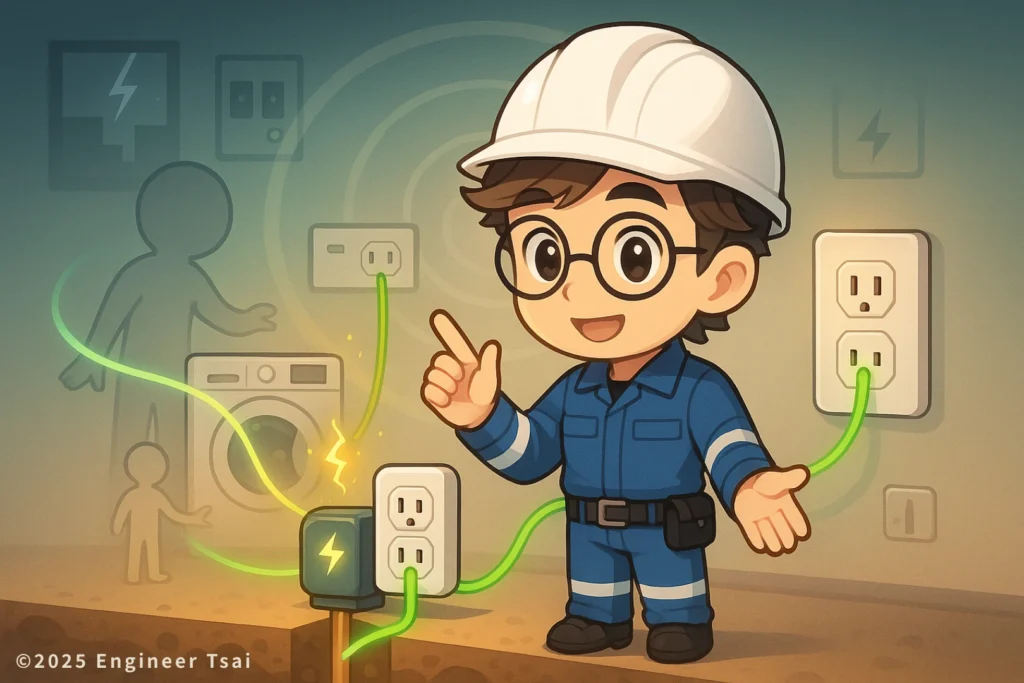
If you want a full understanding of how home electrical systems work, start with the safety overview: 🔹 “Home Electrical Safety Guide: Panels, Breakers, Grounding, AFCI/GFCI, and Common Faults”
Once you know the big picture, this article becomes much easier to follow.
Watch now: What is electrical grounding, and how does it keep you safe?
Quick answer: Electrical grounding is the practice of connecting parts of an electrical system to the earth so that dangerous fault current has a low-resistance path away from people, pets, and equipment. In a typical U.S. home, that means the metal parts of your appliances and the third prong on your outlets are all tied into the same grounding system.
Electrical grounding is one of the most overlooked – and most important – parts of home electrical safety.
On a standard three-prong outlet in your wall, that round or U-shaped hole is the ground connection. In a lot of older homes, that “third prong” either isn’t connected properly… or isn’t connected at all.
This short video uses everyday examples to show you, in plain language:
What is electrical grounding, and how can one extra wire literally save your life when something goes wrong?
After you watch the video, this article will slow down and fill in the gaps.
Using common home scenarios, we’ll walk through:
- what “ground” actually means,
- the main types of grounding you’ll see in real life,
- what “good grounding” looks like,
- and the most common grounding mistakes people run into.
In one sentence: Electrical grounding is the practice of connecting electrical systems to the earth so that dangerous fault current has a safe path away from people and equipment.
Why do we need electrical grounding in the first place?
In a typical home in the U.S., your utility delivers about 120 V or 240 V AC power.
As soon as electricity is involved, you’re dealing with the risk of:
- shock and electrocution, and
- damage to appliances and electronics.
Electrical grounding is how we give fault current a safe way home – a low-resistance path into the earth – instead of letting it travel through a person or through sensitive equipment.
In practical terms, good electrical grounding helps you:
- Reduce shock risk
When something leaks or shorts, current prefers to go into the earth instead of through your body. - Protect equipment
During lightning, surges, or internal faults, grounding helps carry excess energy away so you’re less likely to fry a power supply or motherboard. - Stabilize system voltage
Grounding provides a common reference point so your system voltages don’t float around as much. Sensitive electronics run more smoothly and predictably.
So grounding is not just for big factories or substations.
It’s directly tied to the safety of your fridge, washer, dryer, A/C, computer, and especially any water-related appliance like an electric water heater.
What is electrical grounding?
Grounding (also called “ground” or “earth”) means:
Connecting a specific point in an electrical system solidly to the earth, so that point stays near 0 V and acts as both a reference and a safe exit for fault current.
When insulation breaks down, a wire loosens, or a live conductor touches a metal case by mistake, that metal surface can become energized.
A proper grounding system gives fault current a low-impedance path straight into the earth. That way, the current doesn’t have much reason to:
- go through a person touching the metal case, or
- jump into other circuits where it can cause even more trouble.
In many systems, that fault current flowing to ground also helps trip breakers or ground-fault devices quickly, cutting power before someone gets hurt.
Main functions of grounding
You can think of electrical grounding as doing three jobs at the same time:
- Preventing shock
In a fault, the ground path “pulls” current away from your body by offering a much easier route. - Protecting equipment
With proper grounding, surges, lightning energy, or internal faults can be handled together with fuses, breakers, surge protectors, and lightning arresters. - Stabilizing operation
A solid reference point reduces noise and drift in voltages, which is important for audio systems, communications equipment, industrial controls, and measurement devices.
The main types of electrical grounding you’ll see in real life
“Ground” is not just one thing.
Depending on the purpose, you’ll see a few different kinds of electrical grounding. In a single building, several types often exist side by side and are bonded together at specific points by design.
1. Protective grounding (PE – Protective Earth)
- Focus: human safety.
Protective earth is normally connected to metal enclosures and any conductive parts someone might touch. - When an internal fault makes a metal case live, fault current flows through the ground conductor instead of through the person touching it. That current helps your protective devices (breakers, fuses, GFCIs/RCDs) trip quickly.
- Examples:
the metal body of a fridge or washing machine, an electric water heater, a desktop PC case, and the third prong on a three-prong plug.
2. Functional grounding
- Focus: system performance and control stability, not directly shock protection.
- You’ll find functional grounds in things like transformer neutral points, reference points in power systems, and control system grounds. They help stabilize voltages and protect equipment under abnormal conditions.
- Examples:
the grounded neutral point of a transformer, or the reference ground for some industrial control systems.
3. Lightning protection grounding
- Focus: safely carrying very large lightning currents into the earth.
- This is usually designed as a complete system: air terminals (lightning rods), down conductors, and ground electrodes. Together they guide lightning energy away from the structure and its contents.
- Examples:
lightning rods on the roof of tall buildings, communications towers, or large warehouses and plants.
4. Signal grounding
- Focus: noise and interference reduction so that signals stay clean.
- You’ll see signal grounds in audio systems, digital electronics, networking gear, and instrumentation. The design is often more delicate, because bad grounding can add noise instead of removing it.
- Examples:
the ground terminal on an audio system, signal ground on a PCB or motherboard, and grounding arrangements for sensitive measurement instruments.
How to do electrical grounding right – concept level
1. Keep grounding resistance low
One key indicator of grounding quality is ground resistance.
When resistance is low, fault current is much more willing to use the ground path.
Design targets vary, but conceptually:
- For many building and residential grounding systems, designers often aim for a low tens-of-ohms range (around 10 Ω or less) – lower is generally better.
- For substations or critical installations, the goal can be near 1 Ω or even lower, based on more detailed engineering and soil studies.
The exact limits depend on the electrical code in your region, the type of system, and soil conditions. On site, electricians or engineers use a ground resistance tester (earth tester) to check if the system meets the required values.
2. Use proper grounding materials
- Grounding conductors
Common choices are copper or copper-clad steel because they conduct well and resist corrosion. In many countries, ground wires are green or green/yellow so they’re easy to identify. - Ground rods (electrodes)
These are usually galvanized steel or copper-clad steel driven into the soil to create enough contact area with the earth.
In areas with poor soil conditions (rocky, sandy, very dry, or high soil resistivity), designers may add more rods, deeper electrodes, ground rings or grids, or use ground enhancement materials to push resistance down.
3. Don’t casually share ground paths
- Heavy loads like motors and air conditioners shouldn’t share a messy ground path with very sensitive electronics like servers or high-end audio gear. Big inrush currents and electrical noise can couple into signal grounds.
- In larger systems, it’s common to distinguish between protective earth (PE) and signal or logic grounds, then carefully decide where and how they bond together.
Good grounding design is about both safety and noise control.
4. Test and maintain regularly
Grounding is not “install once and forget forever”. Over time:
- soil moisture changes,
- metal parts corrode,
- and wiring gets modified.
All of these can slowly ruin a grounding system that started out fine.
Recommended checks:
- Look for loose, corroded, or damaged ground wires and connections.
- In critical areas, measure ground resistance regularly to make sure it still meets the required values.
Common grounding problems and how to deal with them
Problem 1: Broken or disconnected ground wires
- What’s going on?
Ground wires can break, pull loose, or be removed during renovations. - Why it’s risky
The equipment looks “normal”, but there is no longer any ground protection. A fault could energize the metal case without any low-impedance path to earth. - What to do
Have a qualified electrician inspect the entire ground path, repair or replace conductors and terminations, and then test ground resistance.
Problem 2: Ground resistance is too high
- What’s going on?
Poor soil (rocky, very dry, or sandy), shallow electrodes, or too few ground rods can all produce high resistance. - Why it’s risky
Fault current won’t “like” the ground path. Protective devices might not trip as intended, leaving dangerous voltages on metal parts. - What to do
Options include adding more rods, driving them deeper, installing a ground grid or ring, or using enhancement materials – all under the design and testing of a qualified professional.
Problem 3: Mixing up ground and neutral
- What’s going on?
Someone ties the ground conductor to the neutral (N) in the wrong place, or uses N as a “fake ground” at outlets. - Why it’s risky
If the neutral opens or its voltage drifts, metal cases can become energized. It also introduces noise issues and strange equipment behavior. - What to do
In homes and small commercial spaces, don’t DIY this. A licensed electrician should correct the wiring and make sure neutral-to-ground bonds only exist where the system design and local code allow them.
Key takeaways
- Electrical grounding gives stray or fault current a low-resistance path into the earth instead of through your body.
- It protects both people and equipment when insulation fails, wiring is wrong, or lightning and surges hit.
- A “third prong” on the outlet doesn’t always mean the grounding is actually done right – testing and inspection matter.
- Good electrical grounding and devices like breakers and GFCIs are designed to work together, not replace each other.
FAQ – electrical grounding questions homeowners ask all the time
Q1. My outlets only have two slots. Does that mean I have no ground at all?
Not necessarily – but in many older apartments and rentals, it’s very common to find no real ground.
You can’t be 100% sure just by looking at the faceplate. Safer options:
Have a licensed electrician check outlets with a receptacle tester or meter.
Ask them to open the panel and verify that the grounding bus and grounding conductors actually connect to a proper earth electrode system.
If you’re running large loads (washer, dryer, oven, A/C) from old two-slot outlets using adapters, it’s worth getting a professional assessment as soon as you can.
Q2. Can I just clamp the ground wire to a water pipe or window frame?
This used to be very common, but by modern standards it’s not recommended.
Reasons include:
Water pipes may have been replaced with plastic, which no longer carries current back to earth.
Corrosion and loose clamps drastically reduce effectiveness.
Metal window frames or railings might have been repainted or modified, leaving unreliable contact points.
A much better solution is a dedicated grounding electrode system installed and tested by a professional, then bonded to the electrical panel’s grounding bar with proper conductors.
Q3. Is there a simple way for a homeowner to check if an outlet is grounded?
The most practical and relatively safe option is a plug-in outlet (receptacle) tester – a small device you plug in that lights up patterns to indicate:
whether hot and neutral are reversed, and
whether the ground terminal is present.
Just remember: this is a basic health check, not a full physical exam.
It cannot measure actual ground resistance.
It cannot guarantee there are no hidden issues in the system.
If you have safety concerns or critical equipment, it’s still best to hire a licensed electrician for a full inspection.
Q4. If I already have GFCI / RCD protection, do I still need grounding?
Yes. They work together, not as an either-or choice.
Grounding gives fault current a clear, low-impedance path so exposed parts don’t rise to dangerous voltages.
GFCI / RCD devices look for imbalance (leakage) between hot and neutral and quickly shut off the circuit.
Good grounding actually makes it easier for protective devices to “see” fault current and trip quickly. In some no-ground situations, certain fault conditions are harder to detect.
Summary: good electrical grounding = quieter nerves and safer power
Electrical grounding isn’t some advanced engineer-only topic.
It’s a basic concept anyone who uses electricity every day deserves to understand.
It might just look like an extra wire and a few buried rods, but behind that hardware are:
- your family’s safety,
- the lifespan of your appliances, and
- how your electrical system behaves when something goes wrong.
Key ideas to keep in mind:
- The core job of electrical grounding is to send dangerous current to the right place, not through people or random paths.
- Protective, functional, lightning, and signal grounds each serve different roles, and a real building will often use several types together.
- Electrical grounding isn’t “set and forget” – it needs periodic visual checks and resistance tests, especially in older buildings or damp, corrosive environments.
If you’re a homeowner, renter, or DIY enthusiast, remember this rule of thumb:
You can’t judge electrical grounding quality just by seeing a third hole on the outlet.
If anything feels off – tingling on metal cases, frequent breaker trips when big appliances start, or very old wiring – talk to a licensed electrician. Getting grounding right early is almost always cheaper than cleaning up after a serious fault.
Further reading
- “DIY-Friendly Guide to Voltage and Current”
A plain-language primer to help you understand the relationship between voltage, current, and power before you dive deeper into electrical grounding and faults. - “What Is a Short Circuit and How Do You Prevent It?”
Ground faults, leakage, and short circuits often show up together. This article connects the dots so you can see how current “takes the wrong path”. - “How to Measure Ground Resistance: Tools and Step-by-Step Examples” (coming soon)
A practical look at clamp meters and dedicated ground testers, and what those ohm readings actually mean. - “How Lightning Protection Systems Work” (coming soon)
Why a thin metal rod on a rooftop can help steer a massive lightning strike safely into the ground. - External references
– Ground (electricity) – Wikipedia
– Ground and neutral – Wikipedia
– National Electrical Code (NFPA 70) – overview
If you’ve ever felt a metal case “tingle” or had an A/C that trips the breaker the moment it starts, I’d love to hear your story in the comments. I’ll help you walk through it from a grounding and leakage point of view.
And if you want more real-world electrical safety and troubleshooting stories, don’t forget to subscribe so you don’t miss future posts.