Table of Contents
Start here: do not quit yet—turn the decision into evidence
The most useful electrician career change checklist does not begin with quitting your job, buying tools, or choosing a trade school. It begins by testing whether the work, training route, pay structure, schedule, and safety culture fit your real life.
The video connected six electrical career directions with three broad ways to enter: learn first, work while learning, or transfer skills from another field. This article does not repeat that map. It gives you the next tool: a 30-day validation plan for deciding what to do with it.
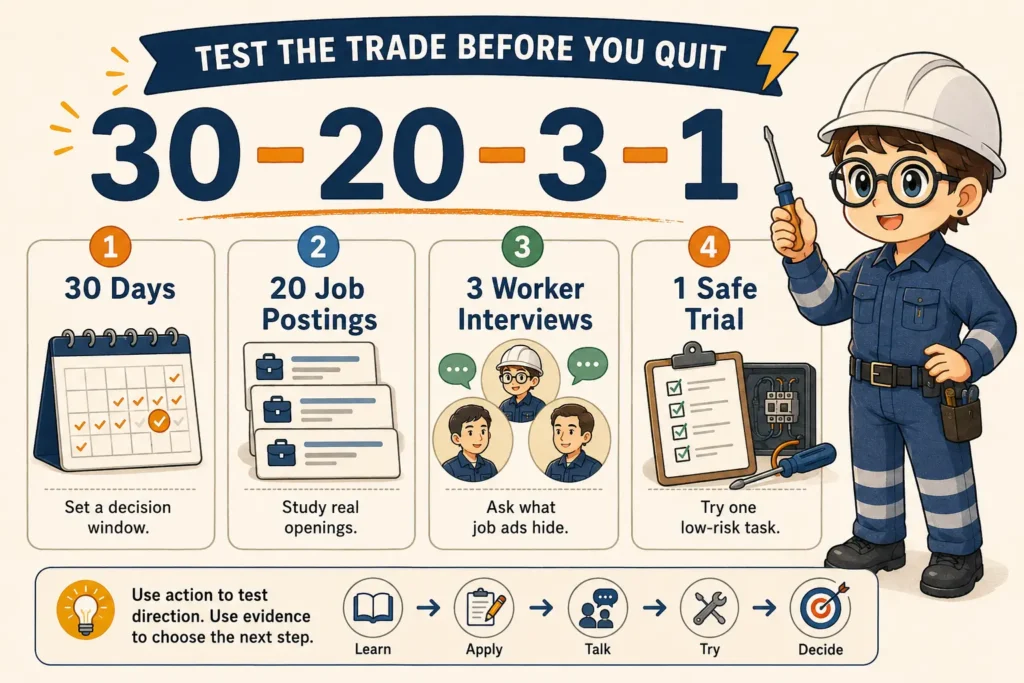
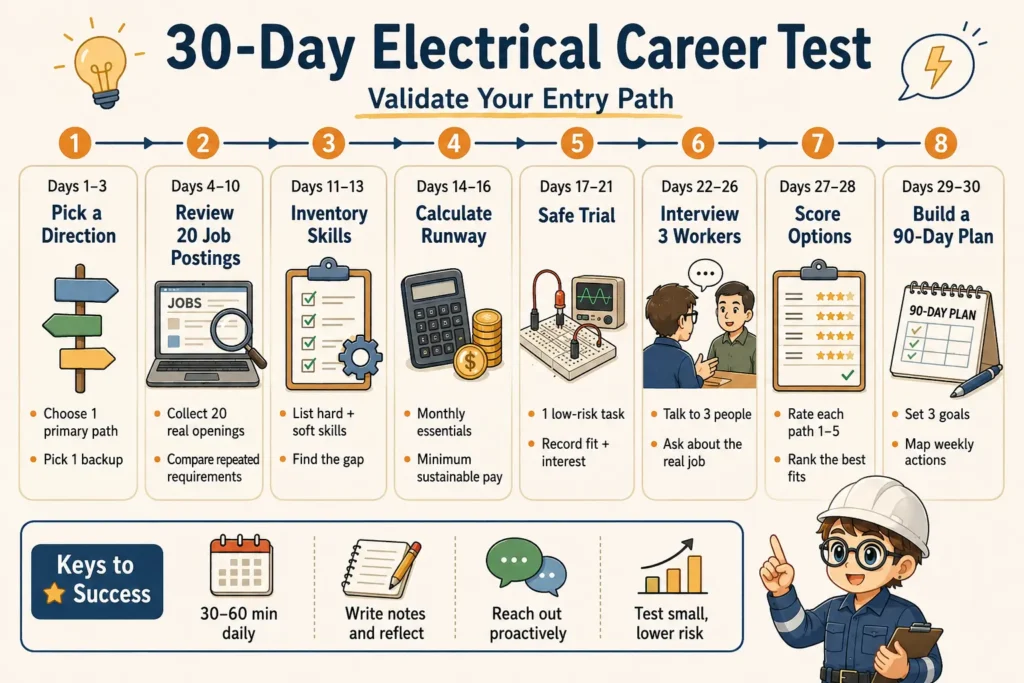
This electrician career change checklist uses the 30-20-3-1 test: spend 30 days studying 20 real openings, interview 3 people who do or supervise the work, and complete 1 safe, deenergized trial. At the end, turn the evidence into a dated 90-day plan.
Your output is not a perfect career answer. Your output is one specific next move—with a date, budget, target job family, and a reason supported by evidence.
The 30-20-3-1 test is an Engineer Tsai career-decision framework. It is not an official U.S. Department of Labor apprenticeship or licensing standard.
▶️ Watch first: three ways to enter electrical work
Watch the video for the high-level map. Then return to this checklist to study real U.S. job titles, Registered Apprenticeships, state-specific licensing questions, transferable skills, and first-job red flags.
What is the 30-20-3-1 electrician career change checklist?
| Number | What you complete | The question it answers |
|---|---|---|
| 30 days | Set a start date and a decision date | When will I stop researching and choose a next move? |
| 20 job postings | Compare real work in one target direction | What does my local market repeatedly require? |
| 3 worker interviews | Ask what job ads do not show | What does this job feel like after the first month and first year? |
| 1 safe trial | Try a core task without live electrical work | Do I enjoy the actual problem—or only the idea of the trade? |
This electrician career change checklist borrows the strongest trait of high-traffic practical articles: one memorable framework that produces a concrete result. You should be able to leave this page with a worksheet, not just a stronger opinion.
U.S. reality check: opportunity, training, and licensing
The U.S. Bureau of Labor Statistics reported a median annual wage of $62,350 in May 2024 for electricians. It projects employment to grow 9% from 2024 to 2034, with about 81,000 openings per year on average. Those numbers describe the occupation as a whole—not beginner pay in your city.
Most electricians learn through an apprenticeship, although some begin in technical school. Registered Apprenticeships combine paid work, mentorship, progressive wage increases, classroom instruction, and a portable credential. Licensing requirements vary by state and sometimes by locality, so a job title alone does not tell you whether your hours will count toward a license.
Do not use national median pay as your entry-level budget. Build your plan from actual local apprentice, helper, trainee, and technician postings.
Step 1 | Pick one electrical direction—not six
Career changers often search electrician apprentice, controls technician, low-voltage installer, solar technician, facilities maintenance, and electrical project coordinator in the same evening. That feels productive, but it produces shallow knowledge of six markets.
For the first 30 days of the electrician career change checklist, choose one primary direction and one backup. Fully test the primary direction. Open the backup only if the primary clearly fails your safety, lifestyle, financial, or interest requirements.
Use Types of Electrical Careers: 6 Paths Beyond Construction to choose among construction electrical, service and maintenance, industrial equipment and controls, low-voltage and building systems, power and energy, and project coordination or management.
I am testing commercial construction electrical as my primary direction because I want visible hands-on progress and structured apprenticeship training. My backup is facilities maintenance because I prefer a more stable work location.
The sentence does not need to remain true forever. It simply forces every job posting, interview, and trial in this month to answer the same question.
Step 2 | Analyze 20 real job postings, not just job titles
A title can hide several different jobs. A “maintenance technician” might change filters and lamps, troubleshoot motors, respond to plumbing calls, or work primarily with controls. An “electrical apprentice” might belong to a structured Registered Apprenticeship—or simply be an entry-level employee with no documented training plan.
Search Apprenticeship.gov, CareerOneStop, state workforce sites, employer career pages, and major job boards. Stay in one direction long enough to collect 20 useful postings.
U.S. search terms for six electrical career directions
| Direction | First search terms | Second search terms |
|---|---|---|
| Construction electrical | electrician apprentice; electrical helper; inside wireman apprentice | commercial electrician apprentice; residential wireman trainee; electrical construction trainee |
| Service and maintenance | service electrician apprentice; maintenance electrician; facilities technician | building maintenance technician; electrical maintenance trainee; field service technician |
| Industrial equipment and controls | industrial electrician apprentice; electrical maintenance technician | controls technician; electro-mechanical technician; instrumentation trainee |
| Low-voltage and building systems | low voltage technician; structured cabling technician | fire alarm apprentice; access control technician; building automation technician |
| Power and energy | solar installer apprentice; substation technician trainee | lineworker apprentice; utility technician; renewable energy technician |
| Project coordination and management | electrical project coordinator; assistant project manager electrical | electrical estimator trainee; BIM technician; VDC electrical coordinator |
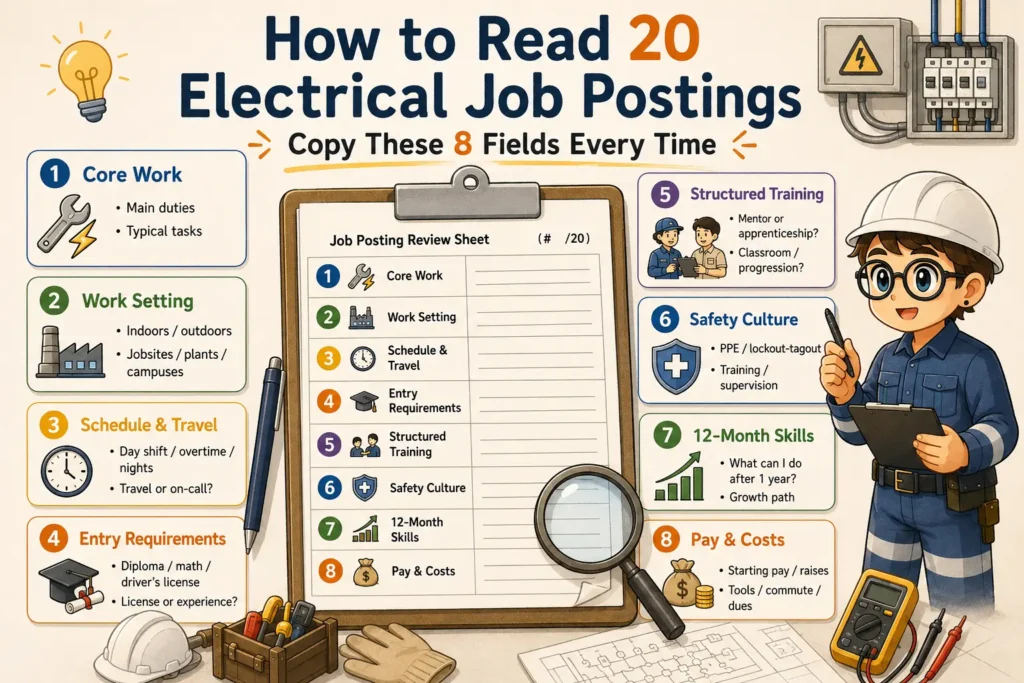
Copy these 8 fields from every job posting
| Field | What to record | Why it matters |
|---|---|---|
| Core work | The three tasks that appear most central | Separates the real job from the title |
| Work setting | Jobsites, homes, plants, hospitals, campuses, outdoors, or offices | Shows whether you can tolerate the environment |
| Schedule and travel | Start time, shifts, overtime, on-call duty, travel, shutdowns | Determines lifestyle and family impact |
| Entry requirements | Education, algebra, license, driver’s license, drug screening, tools, software | Reveals repeated barriers rather than one employer’s wish list |
| Structured training | Registered program, mentor, classroom hours, progression, evaluations | Shows whether the first year builds a real skill path |
| Safety culture | LOTO, PPE, qualified-person language, permits, training, supervision | Safety cannot be discovered after an incident |
| 12-month skill outcome | What you should perform independently after one year | Distinguishes development from indefinite helper work |
| Pay and costs | Base rate, raises, benefits, dues, tuition, tools, travel, per diem | Prevents a misleading comparison based on hourly wage alone |
After 20 postings, circle repeated requirements. If 14 mention blueprint reading, 11 require travel, and 9 describe motor troubleshooting, those patterns are more useful than a random list of certifications from social media.
Create a second column for uncertainty. Examples: “Do these hours count toward licensing?” “Is classroom training paid?” “Who owns the tools?” Those questions become your interview script.
Step 3 | Translate your old experience into electrical value
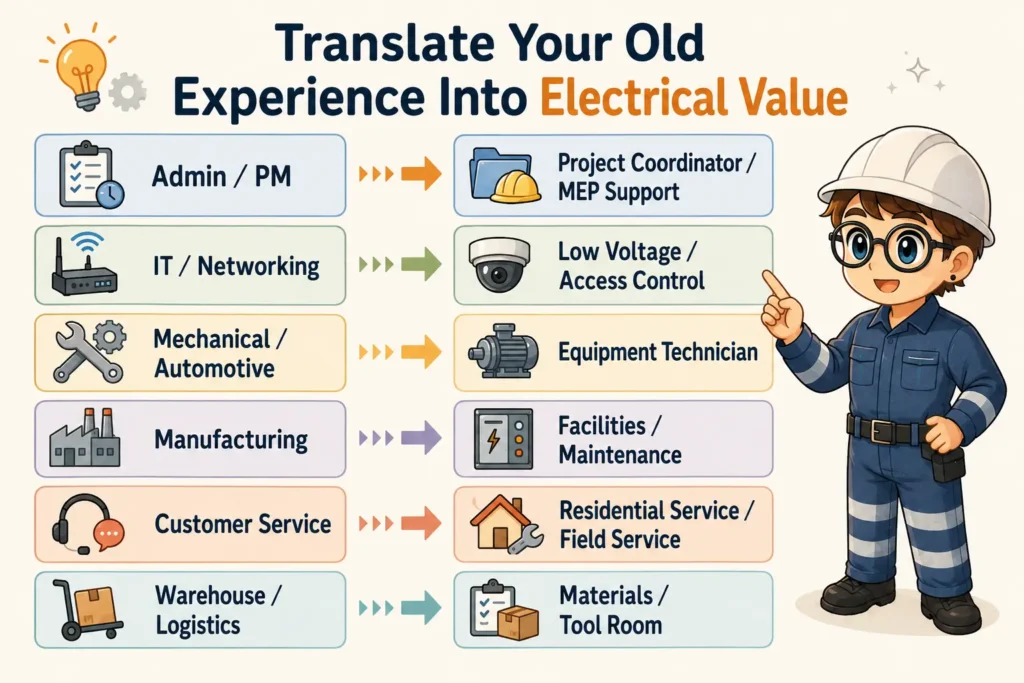
Career changers often erase their previous career and present themselves as empty beginners. That wastes evidence. The better move is to translate old work into problems the target employer recognizes.
| Previous background | Transferable value | Possible bridge roles | Resume evidence |
|---|---|---|---|
| Administration / project management | Scheduling, documentation, vendor follow-up, change tracking | Project coordinator, assistant PM, estimator trainee, electrical office support | Number of vendors, schedules, change orders, deadlines, or incidents coordinated |
| IT / networking | IP addressing, cabling, device configuration, troubleshooting | Low-voltage, access control, CCTV, building automation, controls support | Networks built, devices configured, outages resolved, users supported |
| Mechanical / automotive | Tools, disassembly, maintenance logic, mechanical systems | Industrial maintenance, electro-mechanical technician, equipment service | Equipment serviced, failure causes found, preventive-maintenance tasks completed |
| Manufacturing | Process discipline, safety, shift handoff, downtime response | Facilities, equipment maintenance, industrial electrical trainee | Machines operated, downtime reduced, quality or safety improvements |
| Customer service / hospitality | Questioning, communication, documentation, calm response | Residential service support, field service, facilities, dispatcher-to-technician path | Cases handled, response time, repeat visits, customer outcomes |
| Warehouse / logistics | Materials, inventory, staging, delivery, shortages | Electrical material coordinator, prefab support, tool room, project support | Inventory accuracy, order volume, shortage prevention, delivery coordination |
My transition: what project-management experience did—and did not—replace
My own transition happened in Taiwan, not through a U.S. apprenticeship. I came from a liberal-arts and project-management background, earned Taiwan trade credentials, and later entered MEP construction. Those credentials are not U.S. electrician licenses, and the licensing systems should not be treated as interchangeable.
The transferable lesson is narrower. Drawings changed, materials arrived late, trades blocked one another, and owners changed requirements. My ability to track information, communicate across groups, and keep work moving gave me a way to contribute while my technical ability was still developing.
Project-management skill did not replace electrical theory, code knowledge, safe work practices, or field competence. It created a bridge into the environment where I could build them.
Step 4 | Calculate your financial runway before choosing a route
A career plan that ignores rent, health insurance, transportation, childcare, tools, and unpaid time is not a plan. It is motivation on paper.
Calculate three numbers:
- Bare-bones monthly cost: housing, food, transportation, debt, insurance, childcare, and unavoidable family support.
- Available transition runway: money that can actually support the change, separate from an emergency reserve you cannot spend.
- Minimum acceptable take-home pay: the lowest sustainable amount after taxes, commuting, tools, dues, tuition, and travel costs.
Divide transition runway by bare-bones monthly cost. The result does not choose apprenticeship, school, or a bridge role for you. It tells you which options are financially possible right now.
| Your situation | Reasonable priority | Question to verify |
|---|---|---|
| Strong runway, unclear direction | Use classes, orientations, job shadowing, and foundations to test fit | Does the program lead toward the local jobs you studied? |
| Need income immediately | Prioritize paid apprenticeship, helper, trainee, or technician openings with training | Is the training structured, and will the experience count? |
| Have strong transferable skills | Look for a bridge role that uses old skills while adding technical exposure | Will you actually reach the technical work, or remain only administrative? |
| Direction and finances are both unclear | Complete the 30-day test while keeping your current job | Can you schedule research, interviews, and a safe trial after work? |
Registered Apprenticeships are paid and include progressive wage increases, but openings, starting rates, selection processes, and schedules vary. Use local postings—not national averages—to build your budget.
Step 5 | Complete one safe trial without doing live electrical work
Watching wiring videos can be interesting even when the actual work environment is not. A safe trial helps separate curiosity from fit.
| Direction | Safe trial | What to observe |
|---|---|---|
| Construction electrical | Attend an apprenticeship orientation; identify tools and materials; read a simple plan set | Do sequence, layout, repetitive hands-on work, and jobsite conditions hold your attention? |
| Service and maintenance | Work through a published troubleshooting case and create a symptom-to-cause decision tree | Do you enjoy narrowing possibilities without guessing? |
| Industrial equipment and controls | Read a machine manual or basic control diagram and map start, stop, and protective conditions | Do machine logic and maintenance records feel satisfying or tedious? |
| Low-voltage and building systems | Terminate low-voltage cable on a disconnected training setup or map a simple device topology | Do wiring, addressing, configuration, and troubleshooting fit you? |
| Power and energy | Read a simplified one-line diagram and trace generation, conversion, protection, and distribution | Are you willing to build more theory and follow strict procedures? |
| Project coordination and management | Create a material list, two-week look-ahead, and issue log from a simple drawing set | Do you enjoy dependencies, documentation, and coordination? |
OSHA requires exposed live parts to be deenergized when applicable, and only qualified persons may work on energized circuit parts under the required work practices. Do not use a home switch, receptacle, or open panel as a career experiment.
Step 6 | Interview 3 workers and ask what job postings hide
A job posting may describe duties. It rarely explains whether new workers spend six months staging material, how often shutdowns happen, whether the training director answers questions, or how the crew treats lockout/tagout.
Try to speak with three different perspectives: a first- or second-year apprentice or trainee, an experienced journey-level worker or technician, and a foreman, contractor, training director, or hiring manager.
Ask these eight questions:
- What three tasks take most of your time in a normal week?
- What do career changers misunderstand about this job?
- What does a new person do in the first 90 days?
- What should a good worker be able to do after one year?
- Which part is hardest physically, mentally, and personally?
- How is training documented, and who is responsible for teaching?
- How does the employer handle deenergizing, verification, PPE, and stop-work concerns?
- If you started again with no experience, what would you learn or verify first?
Do not begin by asking for a referral. Ask for 15 to 20 minutes of honest information. At the end, ask about pay progression, benefits, dues, tools, travel, overtime, and the application timeline.
Step 7 | Score your first move instead of choosing by instinct
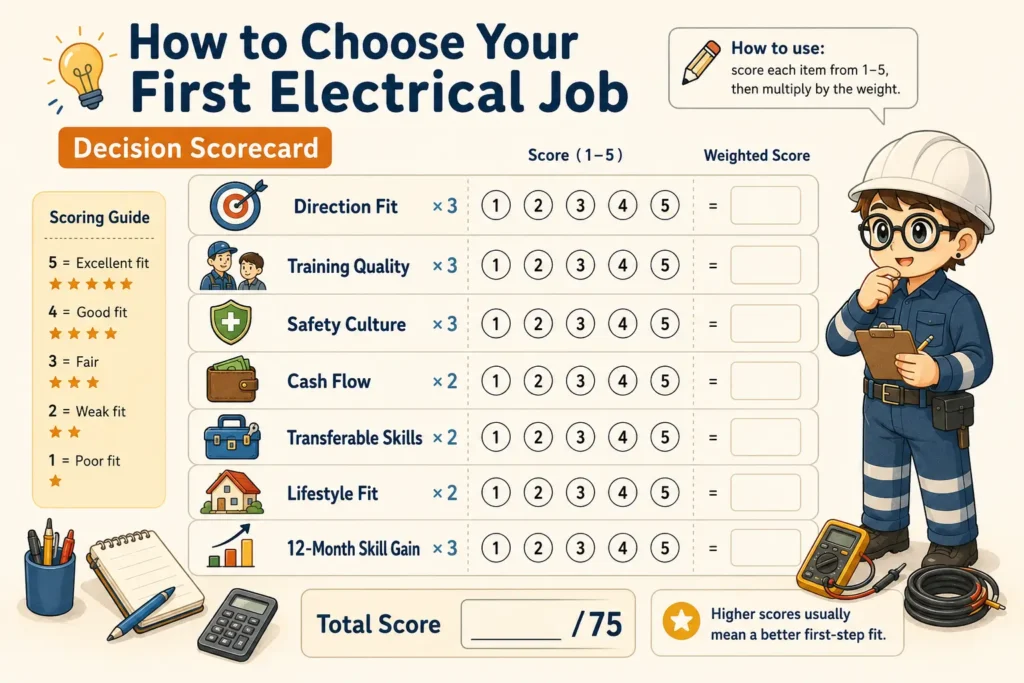
After completing the job analysis, financial calculation, safe trial, and interviews in this electrician career change checklist, you may have three to five realistic options. Score each option from 1 to 5, then apply the suggested weight.
| Criterion | 1 point | 5 points | Weight |
|---|---|---|---|
| Direction fit | Daily work builds the wrong skills | Most work builds the target skill set | ×3 |
| Training quality | No accountable trainer or progression | Mentor, instruction, evaluation, and milestones are clear | ×3 |
| Safety culture | Risk-taking is praised and procedures are vague | Deenergizing, verification, PPE, and responsibilities are clear | ×3 |
| Cash flow | Pay cannot support basic life | Pay and benefits are sustainable through the training period | ×2 |
| Transferable skills | Previous skills create little value | Old skills create immediate value and access to learning | ×2 |
| Lifestyle fit | Schedule, travel, location, or physical demands are unsustainable | You can realistically maintain the role for at least one year | ×2 |
| 12-month skill gain | You may remain in miscellaneous labor | You know what you should perform independently after one year | ×3 |
The 30-day electrician career change checklist
| Days | Work to complete | Deliverable |
|---|---|---|
| Days 1–3 | Choose one primary direction and one backup | One clear validation statement |
| Days 4–10 | Collect and analyze 20 real openings | Repeated requirements, settings, schedules, pay, and unanswered questions |
| Days 11–13 | Inventory transferable skills | Three evidence-backed strengths for a resume or interview |
| Days 14–16 | Calculate runway and minimum sustainable pay | A transition budget |
| Days 17–21 | Complete one deenergized or supervised safe trial | A record of what held your interest and what did not |
| Days 22–26 | Interview three workers at different levels | Three summaries and a list of repeated warnings |
| Days 27–28 | Score three to five options | Ranked jobs, programs, or bridge roles |
| Days 29–30 | Build the next 90-day plan | Applications, training, project, budget, and deadlines |
Turn the results into a 90-day plan
At the end of 30 days, you do not need certainty about the next 20 years. You need one route that can produce better evidence over the next 90 days.
If your next move is learn first
- Compare at least three pre-apprenticeship, trade-school, or community-college options by curriculum, lab time, instructor experience, safety, cost, and employer connections.
- Check local apprenticeship requirements before paying for training that may not be necessary.
- Choose one visible outcome: blueprint literacy, math readiness, a deenergized training-board exercise, or a documented technical project.
- Recheck local postings every two weeks so the learning plan remains tied to the market.
If your next move is work while learning
- Apply to Registered Apprenticeships and carefully reviewed helper, trainee, and technician openings.
- Ask whether the program is registered, how wage progression works, who delivers classroom instruction, and how hours are documented.
- Verify state licensing and experience-credit rules before relying on promised hours.
- Customize five to ten applications per week instead of sending one generic resume to every electrical title.
If your next move is a bridge role
- Rewrite your resume around problems you can solve, not only your old job title.
- Target roles that use your existing skill while exposing you to electrical systems, drawings, equipment, controls, or field coordination.
- Fill one high-impact technical gap rather than collecting several unrelated certificates.
- Prepare two stories showing how your old experience reduced schedule, quality, downtime, communication, inventory, or customer risk.
Red flags in a first electrical job or training program
- The work is impossible to define: the employer cannot explain what changes between month one and year one.
- Training depends on luck: no mentor, curriculum, progression, or evaluation is identifiable.
- Safety questions are mocked: deenergizing, verification, PPE, or stop-work concerns are treated as weakness.
- Licensing promises are vague: nobody can explain whether the employer, supervision, program, or hours meet state requirements.
- You remain a helper indefinitely: there is no timeline for drawings, tools, testing, equipment, or core work.
- Pay is incomplete: wage, raises, overtime, dues, tuition, tools, travel, and per diem are not disclosed clearly.
- The title and work do not match: “project engineer” means only data entry, or “apprentice” means cheap labor without structured learning.
- Turnover is blamed entirely on workers: every person who leaves is described as lazy, while the employer accepts no responsibility.
The fastest route is not automatically the route that builds a recognized skill, documents experience, or protects you. A first role should give you a safer and more valuable second move.
FAQ: testing an electrician career change
Q1: Can this electrician career change checklist really tell me whether the trade is right for me?
This electrician career change checklist cannot show you every part of the trade in 30 days. It can, however, eliminate obvious mismatches and produce a better next step. The goal is not to make a lifetime decision. It is to avoid quitting, paying tuition, or accepting a job before you have studied real openings, your financial runway, and the work itself.
Q2: Why review 20 job postings instead of five?
Five postings can be distorted by one employer or one local specialty. A set of 20 postings makes repeated requirements easier to see: schedules, travel, licensing language, training structure, tools, safety expectations, and the skills employers expect after the first year.
Q3: Where can I find three electrical workers to interview?
Start with apprenticeship open houses, community-college programs, contractors, local trade associations, alumni, LinkedIn, family referrals, or workforce centers. Ask for 15 to 20 minutes of information—not a job referral. Try to speak with one early-career worker, one experienced worker, and one person who trains or hires.
Q4: Can my safe trial include rewiring a switch or receptacle at home?
No. A career trial should not become unsupervised electrical work. Use deenergized training equipment, blueprint reading, materials identification, structured-cabling practice, a troubleshooting case study, a supervised shop demonstration, or an apprenticeship orientation. Do not open energized panels, perform live measurements, or modify building wiring.
Q5: How do I verify that an apprenticeship is registered?
Use Apprenticeship.gov, ask the sponsor for the program name and registration information, and verify details with the applicable U.S. Department of Labor or State Apprenticeship Agency system. A paid entry-level job is not automatically a Registered Apprenticeship.
Q6: Do I need trade school before applying for an electrician apprenticeship?
Not always. The Bureau of Labor Statistics says most electricians learn through an apprenticeship, while some begin with technical school. Requirements vary by sponsor and state. Compare local apprenticeship requirements before paying for a program that may not be required.
Q7: Will electrical-helper hours count toward a future license?
Do not assume they will. Licensing and experience-credit rules vary by state and sometimes by locality. Ask the state licensing board or program sponsor exactly which employer, supervision, registration, documentation, and work classifications are required before accepting a role based on promised hours.
Q8: Should I delete my old career from my resume?
No. Translate the parts that solve problems in the target role: scheduling, documentation, troubleshooting, equipment operation, customer communication, quality, networking, procurement, or safety. Keep evidence and measurable outcomes. Shorten experience that has no connection to the job.
Conclusion: choose the next evidence-producing step
You do not need to choose your final electrical title today. You need to replace imagination with evidence.
Twenty postings show what your local market repeatedly asks for. Three interviews show what the work feels like outside the job ad. One safe trial shows whether the core problem holds your attention. The financial runway and scorecard show which route you can sustain long enough to become useful.
That is the purpose of this electrician career change checklist: not to push everyone into an apprenticeship, but to help each reader choose the next move that produces real learning.
The most valuable result after 30 days is not confidence. It is a 90-day plan with dates, costs, applications, and one measurable skill outcome.
Further reading and watching
- YouTube: Six Electrical Career Directions × Three Ways to Start
- Types of Electrical Careers: 6 Paths Beyond Construction
- Electrician Career Path USA: 0–12 Month Roadmap for Career Changers
- Free Electrician Career Roadmap
- Electrician Learning Map: Full Article Index
- Electrician Career Change in the Age of AI: A 90-Day Guide
Sources and safety notice
- U.S. Bureau of Labor Statistics: Electricians — work, training, pay, and outlook
- Apprenticeship.gov: Registered Apprenticeship for career seekers
- Apprenticeship.gov: Apprenticeship Job Finder
- Apprenticeship.gov: Electrician occupation profile
- CareerOneStop: Electricians occupation profile
- CareerOneStop: License Finder
- OSHA 29 CFR 1910.333: Selection and use of work practices
- OSHA: Control of Hazardous Energy (Lockout/Tagout)
Safety notice: This article is a career-planning guide, not electrical installation or repair instruction. A safe trial must not include unsupervised work on building wiring, energized testing, opening live equipment, or entering controlled electrical spaces. Actual electrical work must follow applicable federal, state, local, employer, and program requirements and be performed under appropriate qualified supervision.
🔹Electrician Career Switch Starter Kit (0–3 Month Action Playbook, PDF)
If this checklist confirmed you’re serious about the trial, use this paid starter kit to structure your first 90 days with its own checklists and a progress tracker, so you’re testing the path with real evidence instead of just reading about it. It’s a learning guide, not a license, and does not guarantee employment or apprenticeship placement.
Read next in this topic
- Electrolysis and Electroplating Explained: How Electric Current Changes Metals in Everyday Life
- Middle East Conflict and the Semiconductor Supply Chain: How It Hits Your Fab, Your MRO Budget, and Your Career
- AI and IoT in Construction: How to Turn Jobsite Tech into Your Career Advantage
- Should You Become an Electrician in the Age of AI?Why I’m Helping People Make the Switch
- 3–12 Months from Zero: A Realistic Roadmap to Switching Careers into the Electrical Trade
- When Cloudflare Went Down, One Thing Became Clear: Why I Help People Become Electricians in the AI Era
- Electrician Career Path USA: 0–12 Month Roadmap for Career Changers
- Electrician Career Paths in the AI Era: 5 Routes and a 0–12 Month Roadmap
- Electric Motors, Generators and VFDs: One Clear Picture from Electromagnetic Induction to Real-World Power Systems
- How to Become an Electrician in the United States
- Industrial Electrician Career Roadmap in the United States
- Types of Electrical Careers: 6 Paths Beyond Construction
- Electrician Career Change Checklist: Test the Trade Before You Quit
- Switching to the Electrical Trade From an Office Job: What the First 12 Months Actually Look Like
- Become an Electrician in Taiwan: Your First-Month Plan
- Becoming an Electrician in California: Trainee, Apprentice, Certification and C-10