These Electrical Guides turn core electrical concepts into short, field-tested lessons with diagrams and checklists. Start with the basics, then follow a learning path for home wiring, safety, and components. Each Electrical Guide ends with a quick task, a tool list, and a study map so you can practice today and return later with confidence.
First, search a topic. Then, pick one guide and finish a quick task. Afterward, use the checklist to confirm the result. Additionally, each article links to tools and study maps, so you can learn fast and act with confidence.
To start, browse the latest posts. Then, pick one guide and try a single task. Afterward, use the checklist to confirm the result. In addition, each article links to tools and study maps, so you can learn and act with confidence.
All articles
-
Leaving or Transferring a Texas Electrical Apprenticeship: What Happens Next?
What to check before leaving or transferring a Texas electrical apprenticeship, including program credit, probation, transcripts and your next steps.
-
NEC 440 Part VII Room Air Conditioners for the Journeyman Exam: The 80 and 50 Percent Rules, Cord Length and the Plug as Disconnect
2026 NEC 440.60 to 440.65 room air conditioners: branch-circuit 80 and 50 percent limits, plug as disconnect, cord length, and leakage-current detection.
-
NEC 310.10(G) Parallel Conductors for the Journeyman Exam: The 1/0 Minimum, Matching Sets and Sizing Large Feeders
2026 NEC 310.10(G) parallel conductors: 1/0 AWG minimum, what each set must match, ampacity adjustment, and 240.4 sizing above and below 800…
-
NEC 250.146 and 250.148 for the Journeyman Exam: Grounding Receptacles and Boxes, and Replacing Two-Prong Outlets
2026 NEC 250.146 and 250.148: bonding receptacles to boxes, self-grounding devices, isolated ground, EGC splices, and two-prong replacement options.
-
NEC 250.110 to 250.119 for the Journeyman Exam: Which Equipment Must Be Grounded and How to Identify the Grounding Conductor
2026 NEC 250.110 to 250.119: when fixed and cord-connected equipment must be grounded, double-insulated tools, and green, bare and reidentified EGCs.
-
NEC Article 240 Fuses and Circuit Breakers for the Journeyman Exam: Plug Fuses, Type S, Interrupting Ratings and Slash-Rated Breakers
2026 NEC Article 240 fuses and breakers: plug fuse limits, Edison base and Type S, cartridge fuses, interrupting ratings, slash ratings and…
-
NEC Article 230 Underground Service Conductors and Service-Entrance Conductors for the Journeyman Exam: Size, Wiring Methods and Protection
2026 NEC Article 230 underground service and service-entrance conductors: minimum size, one set per service, approved wiring methods, protection and support.
-
NEC 210.4 Multiwire Branch Circuits for the Journeyman Exam: Shared Neutral Current, Handle Ties and Grouping
2026 NEC 210.4 multiwire branch circuits: shared neutral current math, simultaneous disconnect, handle ties, line-to-neutral loads and grouping.
-
NEC 680 Spas, Hot Tubs and Fountains for the Journeyman Exam: Emergency Switch, Indoor Distances, GFCI and Bonding
2026 NEC 680.40 to 680.54: spa emergency switch, outdoor and indoor hot tub rules, receptacle and luminaire distances, GFCI, and fountains.
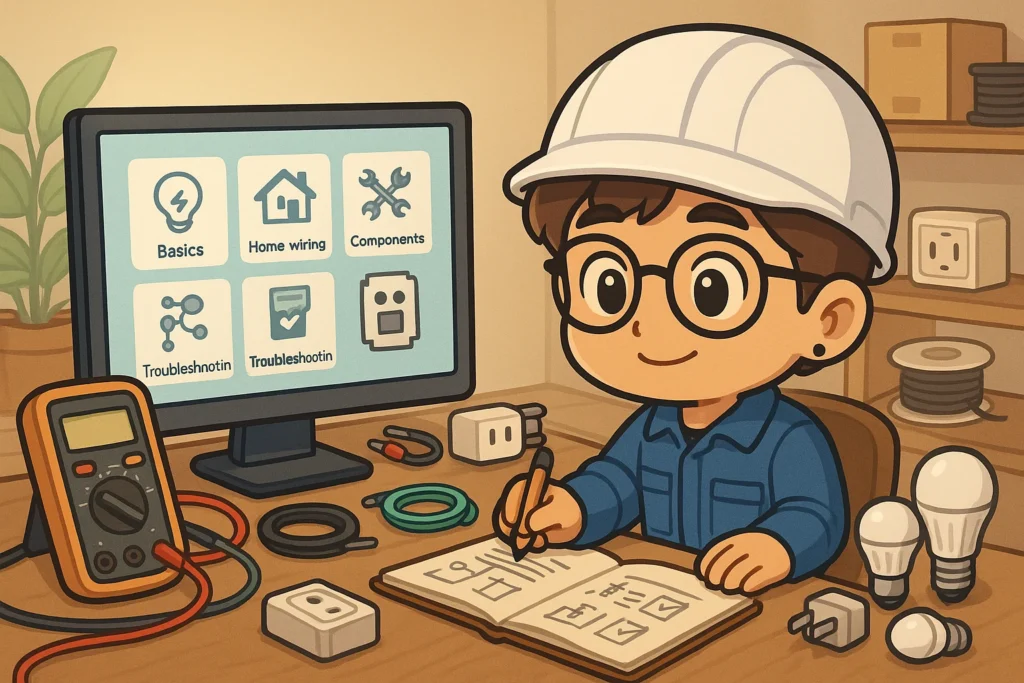
About this Electrical Guides Library
This page is your index for all electrical guides on Tsai Electro. Moreover, you can search and filter tutorials covering basics, home wiring, components, safety and troubleshooting. Because each guide keeps theory short and focuses on steps, diagrams and checklists, you learn faster. As a result, you can move from reading to doing with less guesswork.
Topics These Electrical Guides Cover
Electrical fundamentals · Ohm’s law · AC/DC basics · Home wiring and outlets · Protective devices and relays · Meters and safe measurement · Components and LED drivers · Troubleshooting common faults and practical fixes.
How to Use These Electrical Guides
- First, use the search box or category pills to find a topic.
- Next, open one guide and complete a single task with the checklist.
- Finally, save the tools and diagrams linked inside each article for later jobs.
FAQ
Where should beginners start?
For beginners, start with Tutorials, then the “Electrical Basics” path; after that, move to wiring and safety.
Are these tutorials safe for DIY?
Yes, but always follow safety notes; if unsure, consult a licensed professional.
What tools do I need?
Typically, a non-contact tester, a multimeter, insulated screwdrivers and proper PPE are enough.
What’s the difference between Articles and Tutorials?
In short, Tutorials are step-by-step lessons, whereas Articles are quick reads for specific topics.
Can I use these guides for my home wiring?
However, codes differ by region; therefore, always follow your local electrical code.
Popular paths: