These Electrical Guides turn core electrical concepts into short, field-tested lessons with diagrams and checklists. Start with the basics, then follow a learning path for home wiring, safety, and components. Each Electrical Guide ends with a quick task, a tool list, and a study map so you can practice today and return later with confidence.
First, search a topic. Then, pick one guide and finish a quick task. Afterward, use the checklist to confirm the result. Additionally, each article links to tools and study maps, so you can learn fast and act with confidence.
To start, browse the latest posts. Then, pick one guide and try a single task. Afterward, use the checklist to confirm the result. In addition, each article links to tools and study maps, so you can learn and act with confidence.
All articles
-
NEC 230.24 for the Journeyman Exam: Overhead Service Clearances, Point of Attachment and Service Masts
2026 NEC 230.9, 230.24 and 230.26 to 230.29: clearances over roofs and grade, distance from windows, point of attachment height, service masts…
-
NEC 300.25 Ducts and Plenums for the Journeyman Exam: Firestopping, Ceiling Support and Air-Handling Spaces
2026 NEC 300.13, 300.22, 300.23 and 300.25: support above suspended ceilings, induced currents, firestopping, and wiring in ducts and plenums.
-
NEC 250.20 for the Journeyman Exam: Which Systems Must Be Grounded, Ungrounded Systems and the Main Bonding Jumper
2026 NEC 250.20 to 250.36: which AC systems must be grounded, which conductor is grounded, ungrounded system marking, bonding jumpers and HRG…
-
NEC 410 Recessed Luminaires and Track Lighting for the Journeyman Exam: Clearances, Insulation, Tap Conductors and Supports
2026 NEC 410.115 to 410.155: recessed luminaire temperature, 1/2 in. and 3 in. clearances, IC rating, 18 in. to 6 ft taps,…
-
NEC 230.90 and 230.95 for the Journeyman Exam: Service Overcurrent Protection and Ground-Fault Protection of Equipment
2026 NEC 230.90, 230.91 and 230.95: where service overcurrent devices go, the two to six device rule, and which services need ground-fault…
-
NEC 210.62 to 210.65 for the Journeyman Exam: Show Windows, HVAC Service Receptacles, Guest Rooms and Meeting Rooms
2026 NEC 210.60 to 210.65: show window outlets every 6 ft, HVAC service receptacle within 25 ft, hotel guest rooms and meeting…
-
NEC 120.83 and 120.84 for the Journeyman Exam: Existing Dwelling Additions and the Multifamily Optional Method
2026 NEC 120.83 to 120.87: adding load to an existing dwelling, the multifamily optional method with its demand table, and sizing from…
-
GAN Number Series and Paper Folding: Rules, Traps and 10 Original Questions
⚠ Report an issue on this page × Report an issue on this page If something on this page is unclear, wrong,…
-
GAN Mechanical Reasoning: Gears, Levers, Pulleys and Belts With 8 Original Questions
⚠ Report an issue on this page × Report an issue on this page If something on this page is unclear, wrong,…
About this Electrical Guides Library
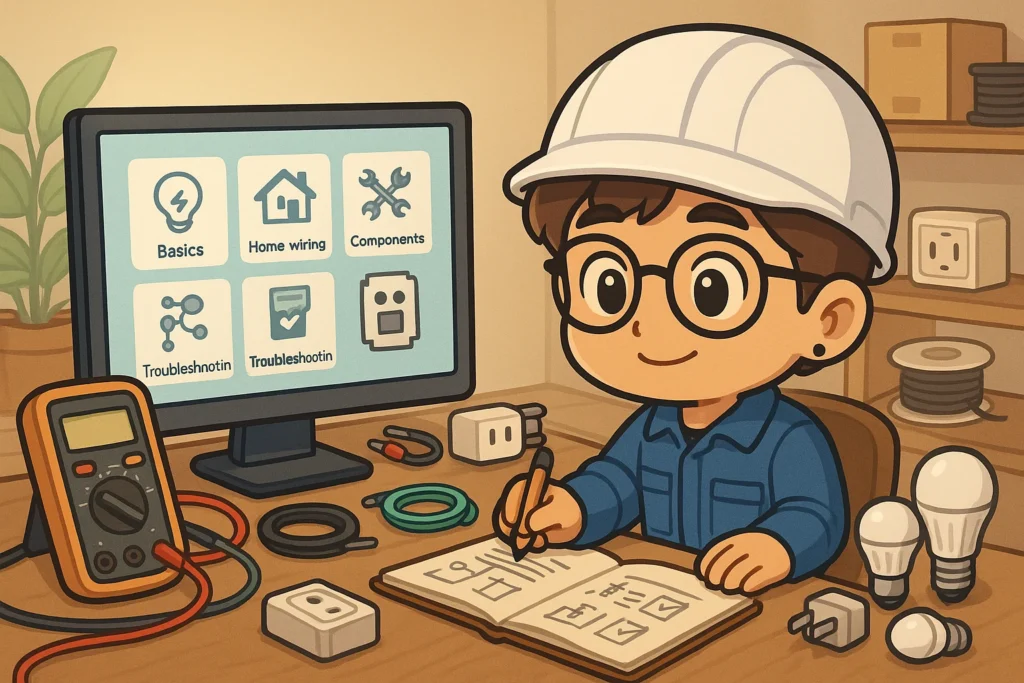
This page is your index for all electrical guides on Tsai Electro. Moreover, you can search and filter tutorials covering basics, home wiring, components, safety and troubleshooting. Because each guide keeps theory short and focuses on steps, diagrams and checklists, you learn faster. As a result, you can move from reading to doing with less guesswork.
Topics These Electrical Guides Cover
Electrical fundamentals · Ohm’s law · AC/DC basics · Home wiring and outlets · Protective devices and relays · Meters and safe measurement · Components and LED drivers · Troubleshooting common faults and practical fixes.
How to Use These Electrical Guides
- First, use the search box or category pills to find a topic.
- Next, open one guide and complete a single task with the checklist.
- Finally, save the tools and diagrams linked inside each article for later jobs.
FAQ
Where should beginners start?
For beginners, start with Tutorials, then the “Electrical Basics” path; after that, move to wiring and safety.
Are these tutorials safe for DIY?
Yes, but always follow safety notes; if unsure, consult a licensed professional.
What tools do I need?
Typically, a non-contact tester, a multimeter, insulated screwdrivers and proper PPE are enough.
What’s the difference between Articles and Tutorials?
In short, Tutorials are step-by-step lessons, whereas Articles are quick reads for specific topics.
Can I use these guides for my home wiring?
However, codes differ by region; therefore, always follow your local electrical code.
Popular paths: