These Electrical Guides turn core electrical concepts into short, field-tested lessons with diagrams and checklists. Start with the basics, then follow a learning path for home wiring, safety, and components. Each Electrical Guide ends with a quick task, a tool list, and a study map so you can practice today and return later with confidence.
First, search a topic. Then, pick one guide and finish a quick task. Afterward, use the checklist to confirm the result. Additionally, each article links to tools and study maps, so you can learn fast and act with confidence.
To start, browse the latest posts. Then, pick one guide and try a single task. Afterward, use the checklist to confirm the result. In addition, each article links to tools and study maps, so you can learn and act with confidence.
All articles
-
IBEW Aptitude Test Score: How Stanines Work, Published Minimums at 16 JATCs, Ranking and Retest Waits (2026)
What a passing IBEW aptitude test score is: the 1 to 9 stanine scale, the minimum score 16 JATCs publish (most say…
-
IBEW Aptitude Test Reading Comprehension: 36 Questions in 51 Minutes, Question Types and How to Read the Passages (2026)
How the reading part of the IBEW/NECA apprenticeship aptitude test works: 36 Reading Comprehension questions in 51 minutes, the question types you…
-
IBEW Aptitude Test Math: The 33 Algebra and Functions Questions, 46 Minutes, No Calculator (2026)
What the math part of the IBEW/NECA apprenticeship aptitude test covers: 33 Algebra and Functions questions in 46 minutes with no calculator.…
-
NEC 675 Irrigation Machines for the Journeyman Exam: Center Pivot Equivalent Current Rating, Disconnects, Grounding and Collector Rings
2026 NEC Article 675 irrigation machines: center pivot equivalent continuous and locked-rotor current, disconnect, grounding and bonding, with worked examples.
-
NEC 660 X-Ray Equipment for the Journeyman Exam: Momentary and Long-Time Ratings, the 50 Percent Rule and Feeder Sizing
2026 NEC Article 660 X-ray equipment: momentary and long-time ratings, branch circuit and disconnect at 50 or 100 percent, feeder sizing and…
-
NEC 504 Intrinsic Safety and 505 Zones for the Journeyman Exam: Control Drawings, Separation, Light Blue Wiring and Zone 0, 1 and 2
2026 NEC Articles 504 and 505: intrinsically safe circuits, control drawings, keeping IS wiring separate, light blue identification and Zone 0, 1…
-
NEC 427 Pipeline and Vessel Heat Tracing for the Journeyman Exam: 125 Percent Branch Circuits, Ground-Fault Protection, Warning Labels and Disconnects
2026 NEC Article 427 heat tracing for pipelines and vessels: 125 percent continuous load, equipment ground-fault protection, caution labels and disconnects.
-
NEC 411 Low-Voltage Lighting and 402 Fixture Wires for the Journeyman Exam: Listing, Where It Cannot Go, 18 AWG Minimum and Fixture Wire Ampacity
2026 NEC Articles 411 and 402: low-voltage lighting systems, listing and location limits, fixture wire minimum 18 AWG, fixture wire ampacity and…
-
NEC 342 IMC and 360 Flexible Metallic Tubing for the Journeyman Exam: Where Each Is Allowed, Sizes, Bends and the 6-Foot Limit
2026 NEC Articles 342 and 360: where IMC and flexible metallic tubing are allowed, trade sizes, 360 degrees of bends, IMC supports…
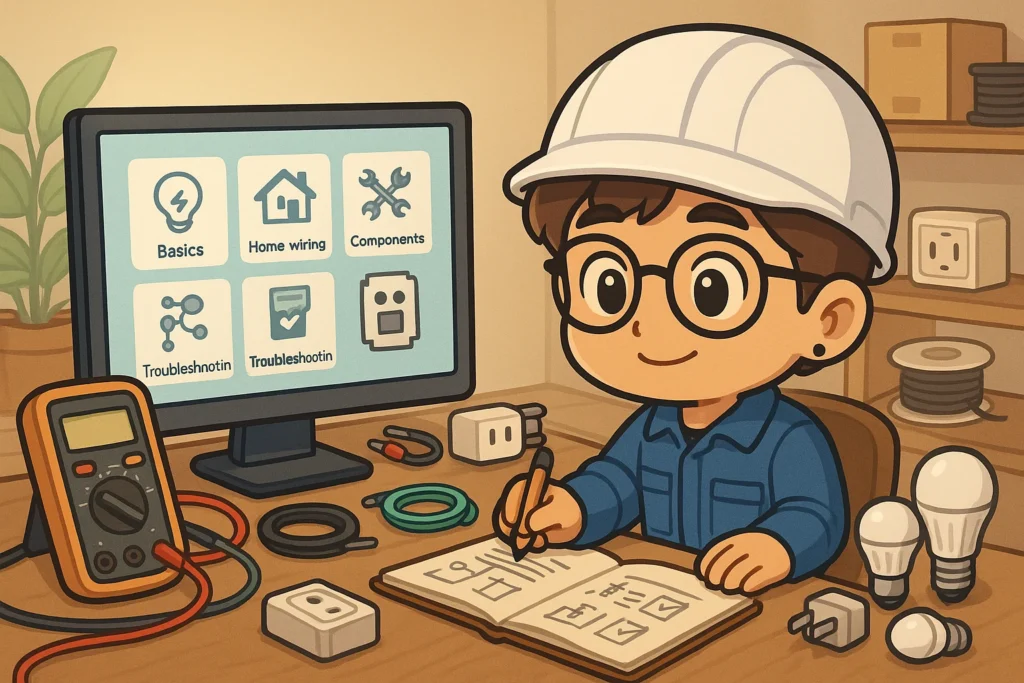
About this Electrical Guides Library
This page is your index for all electrical guides on Tsai Electro. Moreover, you can search and filter tutorials covering basics, home wiring, components, safety and troubleshooting. Because each guide keeps theory short and focuses on steps, diagrams and checklists, you learn faster. As a result, you can move from reading to doing with less guesswork.
Topics These Electrical Guides Cover
Electrical fundamentals · Ohm’s law · AC/DC basics · Home wiring and outlets · Protective devices and relays · Meters and safe measurement · Components and LED drivers · Troubleshooting common faults and practical fixes.
How to Use These Electrical Guides
- First, use the search box or category pills to find a topic.
- Next, open one guide and complete a single task with the checklist.
- Finally, save the tools and diagrams linked inside each article for later jobs.
FAQ
Where should beginners start?
For beginners, start with Tutorials, then the “Electrical Basics” path; after that, move to wiring and safety.
Are these tutorials safe for DIY?
Yes, but always follow safety notes; if unsure, consult a licensed professional.
What tools do I need?
Typically, a non-contact tester, a multimeter, insulated screwdrivers and proper PPE are enough.
What’s the difference between Articles and Tutorials?
In short, Tutorials are step-by-step lessons, whereas Articles are quick reads for specific topics.
Can I use these guides for my home wiring?
However, codes differ by region; therefore, always follow your local electrical code.
Popular paths: