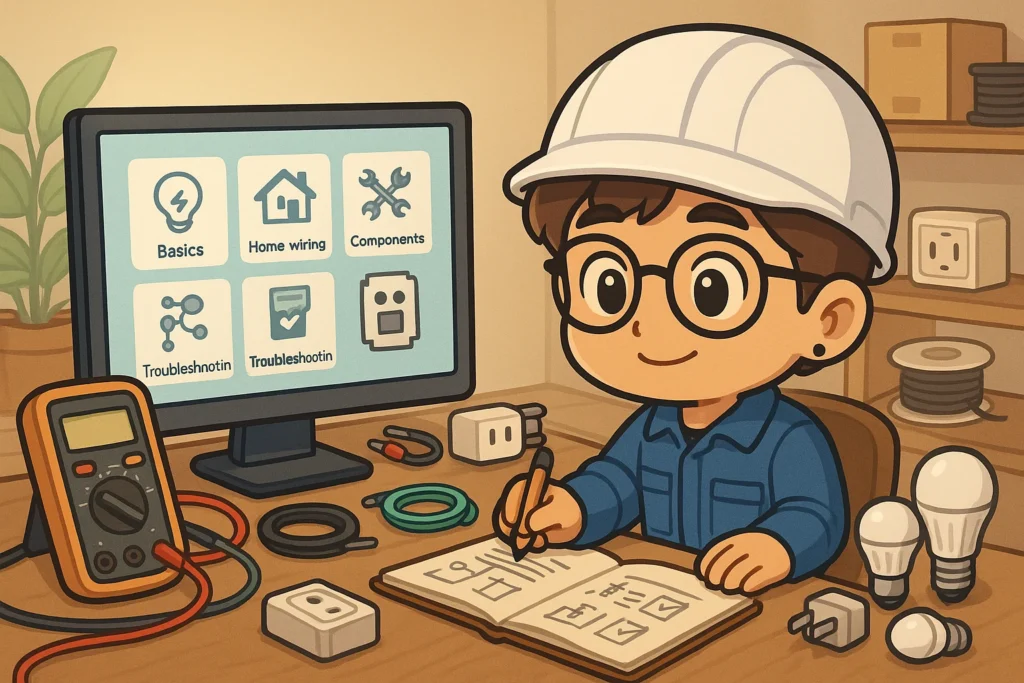
These Electrical Guides turn core electrical concepts into short, field-tested lessons with diagrams and checklists. Start with the basics, then follow a learning path for home wiring, safety, and components. Each Electrical Guide ends with a quick task, a tool list, and a study map so you can practice today and return later with confidence.
First, search a topic. Then, pick one guide and finish a quick task. Afterward, use the checklist to confirm the result. Additionally, each article links to tools and study maps, so you can learn fast and act with confidence.
To start, browse the latest posts. Then, pick one guide and try a single task. Afterward, use the checklist to confirm the result. In addition, each article links to tools and study maps, so you can learn and act with confidence.
All articles
-
NEC 340 UF Cable for the Journeyman Exam: Where Underground Feeder Cable Can Go, the 11 Places It Cannot and Its 60°C Ampacity
2026 NEC Article 340 Type UF cable: direct burial and wet locations, the eleven uses not permitted, service entrance and sunlight traps,…
-
NEC 120 Commercial Load Calculation for the Journeyman Exam: Lighting VA per Square Foot, Receptacles, Show Windows and Kitchens
2026 NEC Article 120 commercial load calculation: lighting VA per square foot, 180 VA receptacles, the 10 kVA receptacle demand, show windows…
-
NEC 800 and 820 for the Journeyman Exam: Communications and CATV Cable Entering a Building, Clearances and Bonding
2026 NEC Articles 800 and 820: overhead and underground clearances, the 50 ft unlisted cable rule, 6 ft from lightning conductors and…
-
NEC 610 Cranes and Hoists for the Journeyman Exam: Conductor Sizing From Nameplate Current and Disconnect Ratings
2026 NEC Article 610 cranes and hoists: conductors from motor nameplate current, the largest motion plus 50 percent rule and the 50/75…
-
NEC 525 Carnivals, Circuses and Fairs for the Journeyman Exam: Overhead Clearance, Ride Disconnects, Cords and GFCI
2026 NEC Article 525: 15 ft from overhead lines, a ride disconnect within sight and 6 ft of the operator, extra-hard usage…
-
NEC 502 and 503 for the Journeyman Exam: Class II Dust and Class III Fiber Locations, Wiring Methods and Seals
2026 NEC Articles 502 and 503: Class II dust and Class III fiber wiring methods by division, the 10 ft and 5…
-
NEC 386 Surface Metal Raceway for the Journeyman Exam: Uses, the 300 Volt Limit, Fill, Splices and Derating
2026 NEC Article 386 surface metal raceway: where it is allowed, the 300 V thickness rule, the three-part derating exemption and the…
-
NEC 338 Service-Entrance Cable for the Journeyman Exam: SE, SER, SEU and USE, Feeders, Insulation and Bending
2026 NEC Article 338: SE and USE cable uses, bare conductors on feeders, the 60°C limit for 10 AWG and smaller in…
-
NEC 332 MI Cable for the Journeyman Exam: Mineral-Insulated Cable Uses, Bending Radius, Support and End Seals
2026 NEC Article 332 MI cable: where it may go, the 5 and 10 times bending radius, 6 ft supports, grouping single…
About this Electrical Guides Library
This page is your index for all electrical guides on Tsai Electro. Moreover, you can search and filter tutorials covering basics, home wiring, components, safety and troubleshooting. Because each guide keeps theory short and focuses on steps, diagrams and checklists, you learn faster. As a result, you can move from reading to doing with less guesswork.
Topics These Electrical Guides Cover
Electrical fundamentals · Ohm’s law · AC/DC basics · Home wiring and outlets · Protective devices and relays · Meters and safe measurement · Components and LED drivers · Troubleshooting common faults and practical fixes.
How to Use These Electrical Guides
- First, use the search box or category pills to find a topic.
- Next, open one guide and complete a single task with the checklist.
- Finally, save the tools and diagrams linked inside each article for later jobs.
FAQ
Where should beginners start?
For beginners, start with Tutorials, then the “Electrical Basics” path; after that, move to wiring and safety.
Are these tutorials safe for DIY?
Yes, but always follow safety notes; if unsure, consult a licensed professional.
What tools do I need?
Typically, a non-contact tester, a multimeter, insulated screwdrivers and proper PPE are enough.
What’s the difference between Articles and Tutorials?
In short, Tutorials are step-by-step lessons, whereas Articles are quick reads for specific topics.
Can I use these guides for my home wiring?
However, codes differ by region; therefore, always follow your local electrical code.
Popular paths: