These Electrical Guides turn core electrical concepts into short, field-tested lessons with diagrams and checklists. Start with the basics, then follow a learning path for home wiring, safety, and components. Each Electrical Guide ends with a quick task, a tool list, and a study map so you can practice today and return later with confidence.
First, search a topic. Then, pick one guide and finish a quick task. Afterward, use the checklist to confirm the result. Additionally, each article links to tools and study maps, so you can learn fast and act with confidence.
To start, browse the latest posts. Then, pick one guide and try a single task. Afterward, use the checklist to confirm the result. In addition, each article links to tools and study maps, so you can learn and act with confidence.
All articles
-
NEC 200 Grounded Conductor Identification for the Journeyman Exam: White, Gray, Stripes and Re-Identification
2026 NEC Article 200: how the grounded conductor is marked by size, when white may be re-identified, grouping neutrals and screw shell…
-
NEC 215 Feeders for the Journeyman Exam: Minimum Conductor Size, the 125% Rule, Feeder Breakers and the 2026 Section Numbers
Size a feeder under the 2026 NEC: 215.4(A)(1) minimum ampacity, the correction check, the 215.5 breaker, the neutral exception and the new…
-
NEC 455 Phase Converters and 460 Capacitors for the Journeyman Exam: What They Do and How the Motor Overload Changes
2026 NEC phase converters (455) and power factor capacitors (460): the manufactured phase, stored charge, and why the motor overload is set…
-
NEC 376, 366 and 368 for the Journeyman Exam: Wireway Fill, Gutter Bus Bars and Busway Support Worked Out
2026 NEC wireways (376), auxiliary gutters (366) and busways (368): the 20 percent fill, 75 percent at splices, 30 conductors and 5…
-
NEC 362 ENT and 320 AC Cable for the Journeyman Exam: Where They Go, How They Are Supported and Attic Protection
2026 NEC ENT (362) and AC cable (320): the three-floor limit, 3 ft straps, anti-short bushings, no wet locations and the 6…
-
NEC 314.28 Pull and Junction Box Sizing for the Journeyman Exam: Straight Pulls, Angle Pulls and Rows Worked Out
Size a pull box under 2026 NEC 314.28: 8 times the largest raceway for straight pulls, 6 times plus the rest of…
-
NEC 312 and 404 for the Journeyman Exam: Cabinet Wiring Space, Wet Locations and Switch Installation Rules
2026 NEC cabinets (312) and switches (404): the 40 and 75 percent wiring space limits, wet-location fittings, knife switch position and 6…
-
NEC 250.30 Separately Derived Systems for the Journeyman Exam: Bonding Jumper, Electrode and GEC Size Step by Step
How 2026 NEC 250.30 grounds a transformer secondary: one bonding point, the building electrode, a GEC sized from the derived conductors, worked…
-
NEC 250.118 with 348 and 350 for the Journeyman Exam: When Flexible Conduit Counts as the Equipment Grounding Conductor
2026 NEC 250.118 lists what can serve as the equipment ground. See when LFMC qualifies: 3/8 to 1/2 trade size, 20 A…
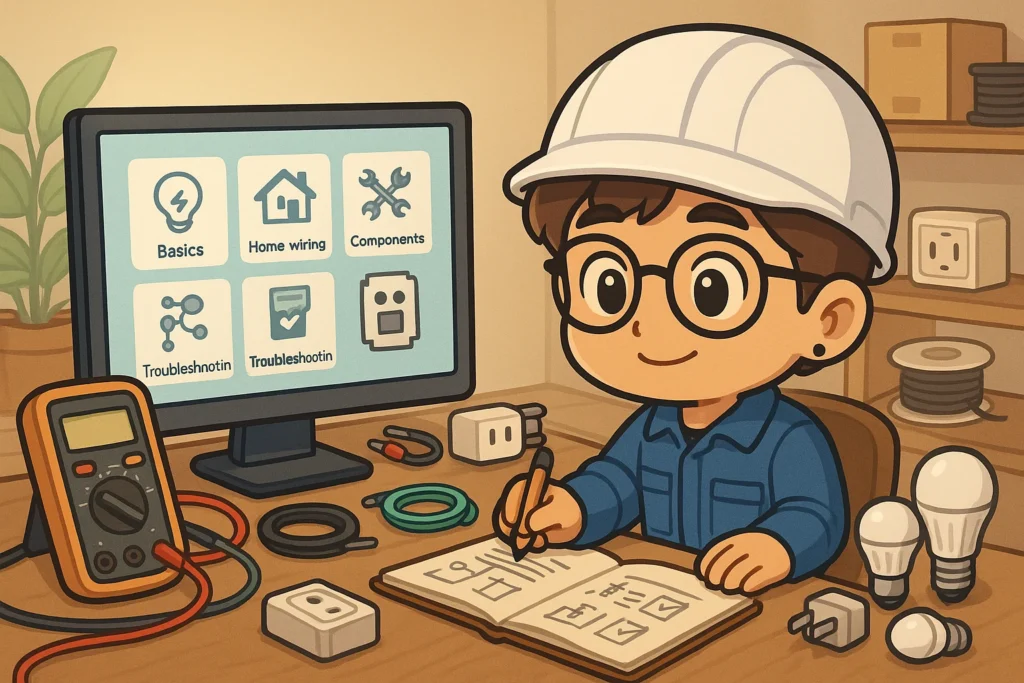
About this Electrical Guides Library
This page is your index for all electrical guides on Tsai Electro. Moreover, you can search and filter tutorials covering basics, home wiring, components, safety and troubleshooting. Because each guide keeps theory short and focuses on steps, diagrams and checklists, you learn faster. As a result, you can move from reading to doing with less guesswork.
Topics These Electrical Guides Cover
Electrical fundamentals · Ohm’s law · AC/DC basics · Home wiring and outlets · Protective devices and relays · Meters and safe measurement · Components and LED drivers · Troubleshooting common faults and practical fixes.
How to Use These Electrical Guides
- First, use the search box or category pills to find a topic.
- Next, open one guide and complete a single task with the checklist.
- Finally, save the tools and diagrams linked inside each article for later jobs.
FAQ
Where should beginners start?
For beginners, start with Tutorials, then the “Electrical Basics” path; after that, move to wiring and safety.
Are these tutorials safe for DIY?
Yes, but always follow safety notes; if unsure, consult a licensed professional.
What tools do I need?
Typically, a non-contact tester, a multimeter, insulated screwdrivers and proper PPE are enough.
What’s the difference between Articles and Tutorials?
In short, Tutorials are step-by-step lessons, whereas Articles are quick reads for specific topics.
Can I use these guides for my home wiring?
However, codes differ by region; therefore, always follow your local electrical code.
Popular paths: