These Electrical Guides turn core electrical concepts into short, field-tested lessons with diagrams and checklists. Start with the basics, then follow a learning path for home wiring, safety, and components. Each Electrical Guide ends with a quick task, a tool list, and a study map so you can practice today and return later with confidence.
First, search a topic. Then, pick one guide and finish a quick task. Afterward, use the checklist to confirm the result. Additionally, each article links to tools and study maps, so you can learn fast and act with confidence.
To start, browse the latest posts. Then, pick one guide and try a single task. Afterward, use the checklist to confirm the result. In addition, each article links to tools and study maps, so you can learn and act with confidence.
All articles
-
NEC 250.104 and 250.92 to 250.94 for the Journeyman Exam: Bonding Piping, Structural Steel, Service Raceways and the Intersystem Terminal
2026 NEC bonding beyond the EGC: water and gas piping, structural steel (250.104), service raceways (250.92) and the intersystem bonding terminal.
-
Texas Master Electrician Exam and Contractor Readiness: What It Tests, How It Differs From Journeyman, and Who Qualifies (2026)
The Texas Master Electrician exam in detail: eligibility (2 years as a Journeyman and 12,000 hours), the two-part PSI exam on the…
-
Texas Maintenance Electrician License: Requirements, the Exam, the In-House Exemption and How It Compares With Journeyman (2026)
How the Texas Maintenance Electrician license works: 8,000 hours under a Master or Maintenance Electrician, the $20 mailed application, the 60-item PSI…
-
Texas Journeyman Lineman License: Who Needs It, the 7,000-Hour and 3.5-Year Routes, and the 40-Item Exam (2026)
How the TDLR Journeyman Lineman license works in Texas: what lineman work it covers, who is exempt (including utility work under the…
-
Fire Alarm Work in Texas: Who Regulates It, Which License You Need, and How It Relates to an Electrician License (2026)
Who regulates fire alarm work in Texas and what it means for electricians: TDLR’s electrician-licensing exemption for fire alarm circuits, the State…
-
Texas Apprentice Electrician, Year 3: Motors, Transformers, Troubleshooting and Getting Ready to Apply for Journeyman (2026)
A guide to the third year of a Texas electrical apprenticeship (about 4,000 to 5,999 hours): the motor, transformer, controls and troubleshooting…
-
Texas Apprentice Electrician, Year 2: What to Learn, How Your Hours Add Up, Pay and Changing Employers (2026)
A guide to the second year of a Texas electrical apprenticeship (about 2,000 to 3,999 hours): the skills to build, how fast…
-
Service and Feeder Load Calculations for the Texas Journeyman Exam: How to Break Down the Problem, With Worked Examples (2026 NEC)
How to break down service and feeder load calculation questions on the Texas Journeyman exam: the dwelling optional method, service conductor sizing,…
-
How to Read a One-Line Diagram, Panel Schedule and Electrical Specs: Trace a Feeder From Source to Panel, With Worked Examples
An apprentice’s guide to reading electrical one-line diagrams, panel schedules and Division 26 specifications: what each part of a feeder callout means,…
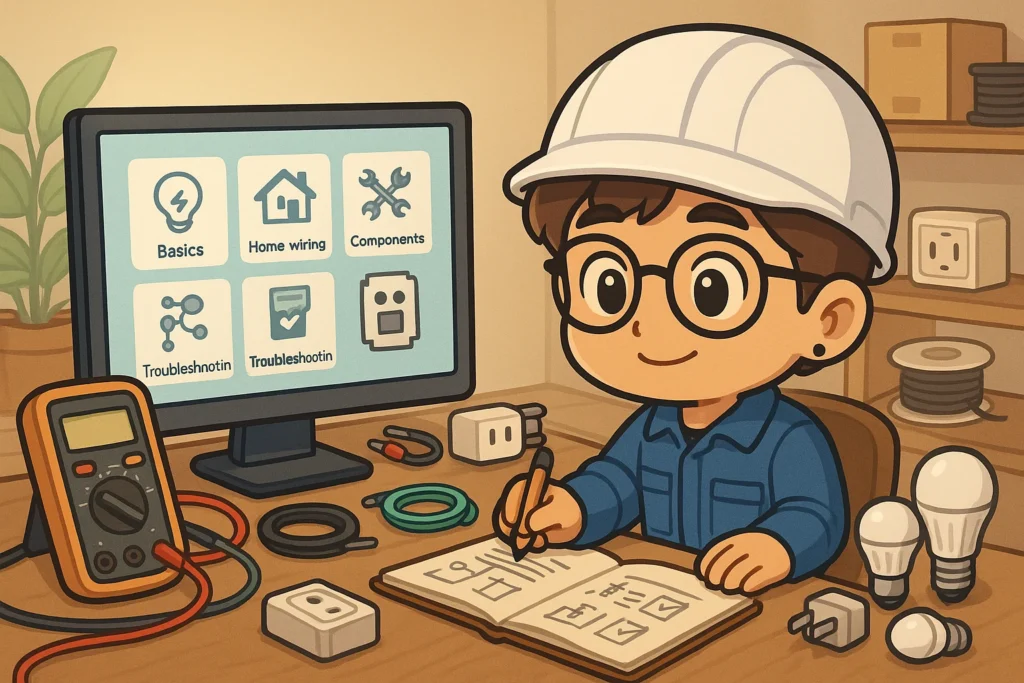
About this Electrical Guides Library
This page is your index for all electrical guides on Tsai Electro. Moreover, you can search and filter tutorials covering basics, home wiring, components, safety and troubleshooting. Because each guide keeps theory short and focuses on steps, diagrams and checklists, you learn faster. As a result, you can move from reading to doing with less guesswork.
Topics These Electrical Guides Cover
Electrical fundamentals · Ohm’s law · AC/DC basics · Home wiring and outlets · Protective devices and relays · Meters and safe measurement · Components and LED drivers · Troubleshooting common faults and practical fixes.
How to Use These Electrical Guides
- First, use the search box or category pills to find a topic.
- Next, open one guide and complete a single task with the checklist.
- Finally, save the tools and diagrams linked inside each article for later jobs.
FAQ
Where should beginners start?
For beginners, start with Tutorials, then the “Electrical Basics” path; after that, move to wiring and safety.
Are these tutorials safe for DIY?
Yes, but always follow safety notes; if unsure, consult a licensed professional.
What tools do I need?
Typically, a non-contact tester, a multimeter, insulated screwdrivers and proper PPE are enough.
What’s the difference between Articles and Tutorials?
In short, Tutorials are step-by-step lessons, whereas Articles are quick reads for specific topics.
Can I use these guides for my home wiring?
However, codes differ by region; therefore, always follow your local electrical code.
Popular paths: