These Electrical Guides turn core electrical concepts into short, field-tested lessons with diagrams and checklists. Start with the basics, then follow a learning path for home wiring, safety, and components. Each Electrical Guide ends with a quick task, a tool list, and a study map so you can practice today and return later with confidence.
First, search a topic. Then, pick one guide and finish a quick task. Afterward, use the checklist to confirm the result. Additionally, each article links to tools and study maps, so you can learn fast and act with confidence.
To start, browse the latest posts. Then, pick one guide and try a single task. Afterward, use the checklist to confirm the result. In addition, each article links to tools and study maps, so you can learn and act with confidence.
All articles
-
NEC 450 Transformers for Apprentices: kVA to Amps, Primary and Secondary Protection, With Worked Examples (2026 NEC)
How to calculate transformer primary and secondary current from kVA, single-phase and three-phase, and how NEC Article 450 sets overcurrent protection on…
-
Industrial Controls for Apprentices: Relays, Contactors, PLCs and What a VFD Is, With Worked Examples
An apprentice’s introduction to industrial controls: the difference between a relay, a contactor and a motor starter, how a PLC scans inputs…
-
IBEW Aptitude Test Prep: A 30-Day Study Plan With Three Timed Mocks (2026)
A day-by-day 30-day plan for the IBEW/NECA apprenticeship aptitude test: what to study each week for the 33 question algebra and 36…
-
IBEW Aptitude Test Practice Questions: 10 Free Sample Questions With Step-by-Step Solutions (2026)
10 free IBEW aptitude test practice questions written by us in the electrical training ALLIANCE style: 6 algebra and functions questions and…
-
Free GAN Aptitude Test Study Plan: Four Weeks of Practice
⚠ Report an issue on this page × Report an issue on this page If something on this page is unclear, wrong,…
-
GAN Aptitude Test: What It Is, Who Uses It, Sections, Timing and How to Apply
⚠ Report an issue on this page × Report an issue on this page If something on this page is unclear, wrong,…
-
Structured Electrical Troubleshooting for Apprentices: From Symptom to Safe Test Plan, With Worked Measurements
A step-by-step troubleshooting process for electrical apprentices: gather the symptom, plan the safe test and the stop condition, measure, split the circuit…
-
NEC 518 and 520 for the Journeyman Exam: Places of Assembly or Theater? How to Pick the Article and Read Its Rules
Pick between 2026 NEC Article 518 places of assembly and Article 520 theaters, then find the wiring method, temporary wiring and stage…
-
NEC 695 Fire Pumps for the Journeyman Exam: Why the Rules Keep the Pump Running and How to Find Them
How 2026 NEC Article 695 keeps a fire pump running: reliable power, protection that rides through starting current, fire-protected conductors.
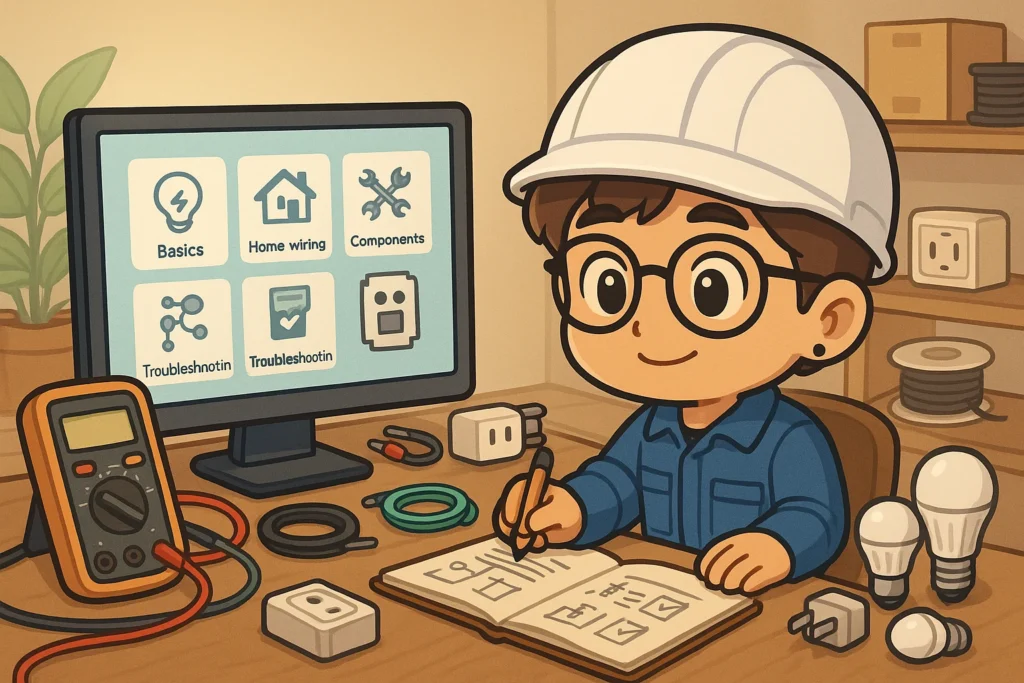
About this Electrical Guides Library
This page is your index for all electrical guides on Tsai Electro. Moreover, you can search and filter tutorials covering basics, home wiring, components, safety and troubleshooting. Because each guide keeps theory short and focuses on steps, diagrams and checklists, you learn faster. As a result, you can move from reading to doing with less guesswork.
Topics These Electrical Guides Cover
Electrical fundamentals · Ohm’s law · AC/DC basics · Home wiring and outlets · Protective devices and relays · Meters and safe measurement · Components and LED drivers · Troubleshooting common faults and practical fixes.
How to Use These Electrical Guides
- First, use the search box or category pills to find a topic.
- Next, open one guide and complete a single task with the checklist.
- Finally, save the tools and diagrams linked inside each article for later jobs.
FAQ
Where should beginners start?
For beginners, start with Tutorials, then the “Electrical Basics” path; after that, move to wiring and safety.
Are these tutorials safe for DIY?
Yes, but always follow safety notes; if unsure, consult a licensed professional.
What tools do I need?
Typically, a non-contact tester, a multimeter, insulated screwdrivers and proper PPE are enough.
What’s the difference between Articles and Tutorials?
In short, Tutorials are step-by-step lessons, whereas Articles are quick reads for specific topics.
Can I use these guides for my home wiring?
However, codes differ by region; therefore, always follow your local electrical code.
Popular paths: