These Electrical Guides turn core electrical concepts into short, field-tested lessons with diagrams and checklists. Start with the basics, then follow a learning path for home wiring, safety, and components. Each Electrical Guide ends with a quick task, a tool list, and a study map so you can practice today and return later with confidence.
First, search a topic. Then, pick one guide and finish a quick task. Afterward, use the checklist to confirm the result. Additionally, each article links to tools and study maps, so you can learn fast and act with confidence.
To start, browse the latest posts. Then, pick one guide and try a single task. Afterward, use the checklist to confirm the result. In addition, each article links to tools and study maps, so you can learn and act with confidence.
All articles
-
NEC 547 Agricultural Buildings for the Journeyman Exam: Why Barns Are Different and How the Equipotential Plane Is Bonded
How 2026 NEC Article 547 treats barns and livestock buildings: why dust and moisture change the wiring, and how the equipotential plane…
-
NEC 250.50 Grounding Electrode System for the Journeyman Exam: Which Electrodes Count, the 25-Ohm Rod Rule and the Install Numbers
Look up the 2026 NEC grounding electrode system: what 250.50 bonds, the 250.52 electrode list, the 25 ohm rule, plate and ring…
-
NEC 344, 352 and 358 for the Journeyman Exam: RMC, PVC and EMT Support, Bend, Expansion and Size Rules Side by Side
Compare 2026 NEC rules for RMC (344), PVC (352) and EMT (358): support spacing, the 360 degree bend limit, PVC expansion worked…
-
NEC 210.8 GFCI and 210.12 AFCI for the Journeyman Exam: How to Read the Voltage, Amp and Location Limits
2026 NEC 210.8 GFCI and 210.12 AFCI lookups: dwelling vs other locations, the 150 V, 50 A and 100 A limits, kitchens,…
-
NEC Table 250.66 and Table 250.122 for the Journeyman Exam: How to Look Up GEC and EGC Sizes Step by Step
Look up the GEC in Table 250.66 and the EGC in Table 250.122: which input each table uses, parallel sets, upsized wire…
-
Three-Phase Power Calculations for Apprentices: Where 1.732 Comes From, kVA to Amps and Wye vs Delta
How to calculate three-phase current, kVA and kW with the 1.732 factor, how line and phase values differ in wye and delta…
-
Ohm’s Law, Power and Series-Parallel Circuits for Apprentices: The Four Formulas and How Exam Questions Use Them
Ohm’s law and the power formulas explained for electrical apprentices, with worked series, parallel and heater-on-the-wrong-voltage examples and the mistakes that cost…
-
NEC 700, 701 and 702 for Apprentices: Emergency, Legally Required and Optional Standby Systems and Their Transfer Switches
How to tell emergency, legally required standby and optional standby systems apart in the 2026 NEC, what each requires for transfer equipment,…
-
NEC 690 PV Calculations for Apprentices: Cold-Weather String Voltage, the 125% Current Factors and Rapid Shutdown Limits
Worked 2026 NEC Article 690 calculations for solar PV: maximum string voltage with Table 690.7(A) or the module coefficient, maximum circuit current,…
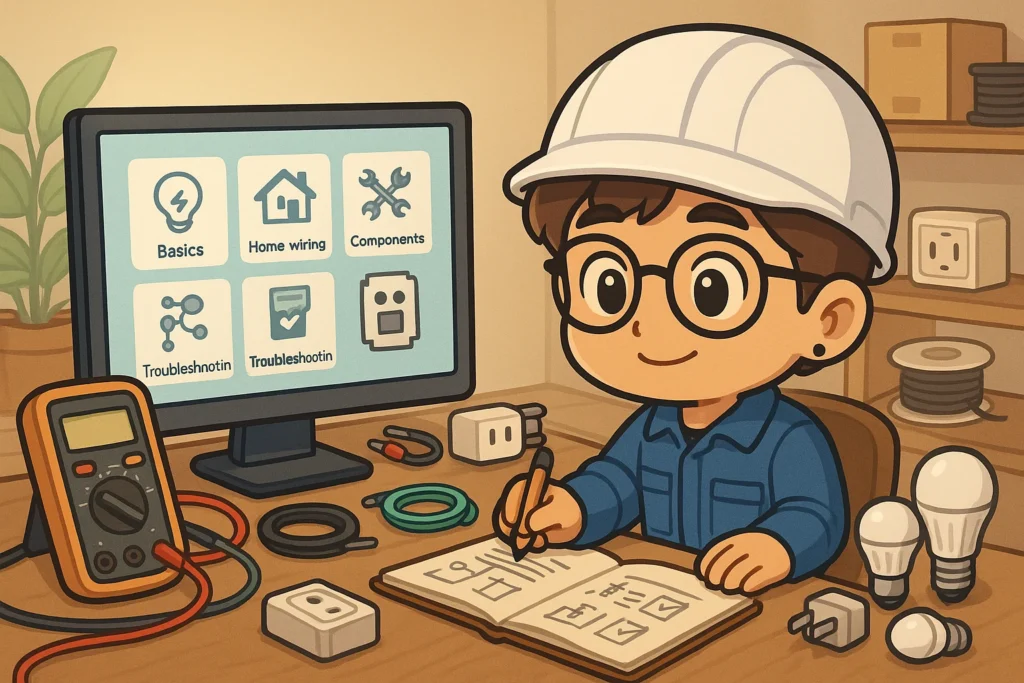
About this Electrical Guides Library
This page is your index for all electrical guides on Tsai Electro. Moreover, you can search and filter tutorials covering basics, home wiring, components, safety and troubleshooting. Because each guide keeps theory short and focuses on steps, diagrams and checklists, you learn faster. As a result, you can move from reading to doing with less guesswork.
Topics These Electrical Guides Cover
Electrical fundamentals · Ohm’s law · AC/DC basics · Home wiring and outlets · Protective devices and relays · Meters and safe measurement · Components and LED drivers · Troubleshooting common faults and practical fixes.
How to Use These Electrical Guides
- First, use the search box or category pills to find a topic.
- Next, open one guide and complete a single task with the checklist.
- Finally, save the tools and diagrams linked inside each article for later jobs.
FAQ
Where should beginners start?
For beginners, start with Tutorials, then the “Electrical Basics” path; after that, move to wiring and safety.
Are these tutorials safe for DIY?
Yes, but always follow safety notes; if unsure, consult a licensed professional.
What tools do I need?
Typically, a non-contact tester, a multimeter, insulated screwdrivers and proper PPE are enough.
What’s the difference between Articles and Tutorials?
In short, Tutorials are step-by-step lessons, whereas Articles are quick reads for specific topics.
Can I use these guides for my home wiring?
However, codes differ by region; therefore, always follow your local electrical code.
Popular paths: