These Electrical Guides turn core electrical concepts into short, field-tested lessons with diagrams and checklists. Start with the basics, then follow a learning path for home wiring, safety, and components. Each Electrical Guide ends with a quick task, a tool list, and a study map so you can practice today and return later with confidence.
First, search a topic. Then, pick one guide and finish a quick task. Afterward, use the checklist to confirm the result. Additionally, each article links to tools and study maps, so you can learn fast and act with confidence.
To start, browse the latest posts. Then, pick one guide and try a single task. Afterward, use the checklist to confirm the result. In addition, each article links to tools and study maps, so you can learn and act with confidence.
All articles
-
NEC 645 Information Technology Equipment for Apprentices: When the Article Applies, the 125% Rule and Where Communications Wiring Fits
What Article 645 of the 2026 NEC covers for IT equipment rooms, why it is optional, how the continuous load rule sizes…
-
NEC 630 Electric Welders for Apprentices: Duty Cycle, Branch Circuit Ampacity and Overcurrent Protection With Worked Examples
How the 2026 NEC sizes supply conductors and overcurrent protection for arc welders: the effective current, the Table 630.11(A) duty cycle multiplier,…
-
NEC 430 Motor Disconnects and Controllers: In Sight Rules, Horsepower Ratings and One Switch for Several Motors
How the 2026 NEC handles motor controllers and disconnecting means: the in sight rules, what a disconnect must open and show, horsepower…
-
NEC 240.21 Feeder Tap Rules for Apprentices: The 10-Foot, 25-Foot and Transformer Secondary Taps With Worked Sizing
How the 2026 NEC 240.21 tap rules work: why conductors are normally protected where they get their supply, the 10-foot and 25-foot…
-
Texas Journeyman Electrician Exam Content Outline (2026 NEC): 20 Subject Areas and How to Study Them
The Texas Journeyman exam outline in one page: 20 subject areas across the NEC Knowledge and Calculations parts, scored questions per area,…
-
Low-Voltage and Fire Alarm Circuits (NEC 725 and 760): Cable Ratings, Separation and Support for Apprentices
Class 2 and Class 3 circuits, fire alarm cable types, plenum and riser ratings, keeping low-voltage cable away from power conductors, and…
-
Swimming Pool Bonding (NEC 680): The Equipotential Grid, GFCI and Clearances for Apprentices
Why pools are bonded, what goes into the equipotential bonding grid, how bonding differs from grounding, GFCI for pool pumps, receptacle and…
-
EV Charger Circuits (NEC 625): Sizing a Level 2 Circuit at 125%, GFCI and the Load You Add to the Service
Learn to size Level 2 EV charger circuits at 125%, check GFCI and disconnect requirements, and calculate the load a charger adds…
-
Temporary Wiring and Available Fault Current (NEC 590 and 110): Jobsite Power Rules for Apprentices
Temporary power on a construction site: how long it may stay, GFCI for jobsite receptacles, protecting lamps and cords, and removal, plus…
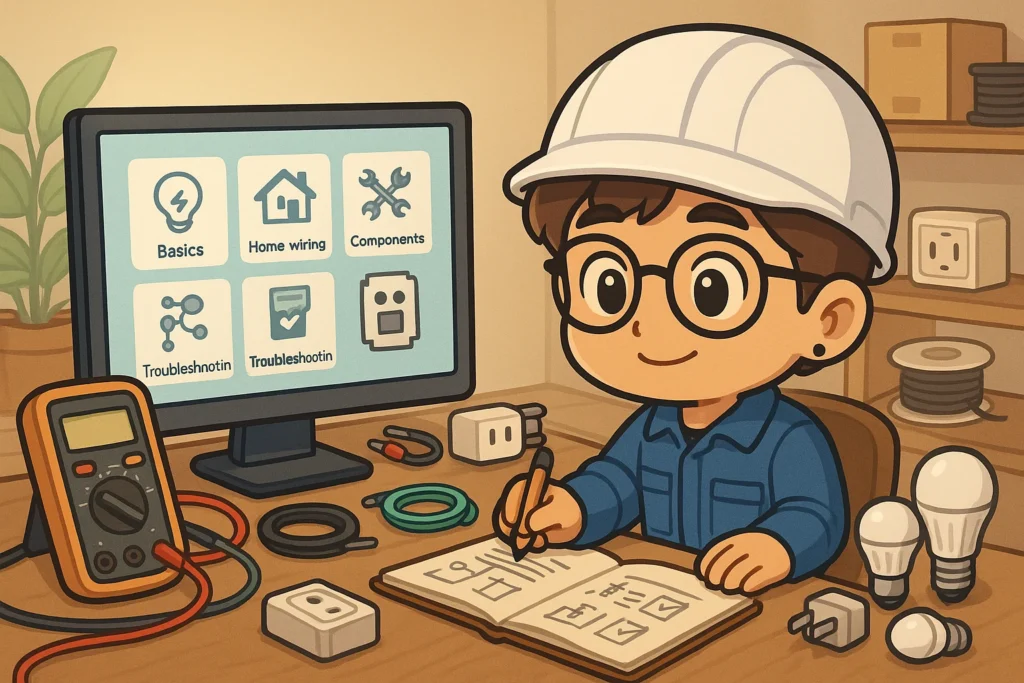
About this Electrical Guides Library
This page is your index for all electrical guides on Tsai Electro. Moreover, you can search and filter tutorials covering basics, home wiring, components, safety and troubleshooting. Because each guide keeps theory short and focuses on steps, diagrams and checklists, you learn faster. As a result, you can move from reading to doing with less guesswork.
Topics These Electrical Guides Cover
Electrical fundamentals · Ohm’s law · AC/DC basics · Home wiring and outlets · Protective devices and relays · Meters and safe measurement · Components and LED drivers · Troubleshooting common faults and practical fixes.
How to Use These Electrical Guides
- First, use the search box or category pills to find a topic.
- Next, open one guide and complete a single task with the checklist.
- Finally, save the tools and diagrams linked inside each article for later jobs.
FAQ
Where should beginners start?
For beginners, start with Tutorials, then the “Electrical Basics” path; after that, move to wiring and safety.
Are these tutorials safe for DIY?
Yes, but always follow safety notes; if unsure, consult a licensed professional.
What tools do I need?
Typically, a non-contact tester, a multimeter, insulated screwdrivers and proper PPE are enough.
What’s the difference between Articles and Tutorials?
In short, Tutorials are step-by-step lessons, whereas Articles are quick reads for specific topics.
Can I use these guides for my home wiring?
However, codes differ by region; therefore, always follow your local electrical code.
Popular paths: