These Electrical Guides turn core electrical concepts into short, field-tested lessons with diagrams and checklists. Start with the basics, then follow a learning path for home wiring, safety, and components. Each Electrical Guide ends with a quick task, a tool list, and a study map so you can practice today and return later with confidence.
First, search a topic. Then, pick one guide and finish a quick task. Afterward, use the checklist to confirm the result. Additionally, each article links to tools and study maps, so you can learn fast and act with confidence.
To start, browse the latest posts. Then, pick one guide and try a single task. Afterward, use the checklist to confirm the result. In addition, each article links to tools and study maps, so you can learn and act with confidence.
All articles
-
Mobile Homes, RV Parks and Marinas (NEC 550, 551 and 555): Service Location, Site Receptacles and the Load Math
Where the service for a mobile home goes, why its feeder has four conductors, what receptacles an RV site needs, ground-fault protection…
-
HVAC and Appliance Circuits (NEC 440 and 422): Reading MCA and MOCP, Water Heaters and Disconnects
How to size an air conditioner circuit from the nameplate MCA and MOCP, why a water heater circuit is sized at 125%,…
-
NEC 404, 406 and 410: Receptacles, Switches and Luminaires for Apprentices
Learn the 2026 NEC rules for receptacles, switches, luminaires and ceiling fan support, including replacement receptacles, switch-box neutrals, damp and wet locations,…
-
Underground Wiring and Burial Depth (NEC 300.7, formerly 300.5): Cover Depths, Driveways and Protection Where It Comes Up
How deep to bury cable and conduit under the NEC, what “cover” means, the shallower depths for GFCI residential circuits, driveways and…
-
Service Equipment for Apprentices (2026 NEC): Meter, Main Disconnect, Panel and Neutral-to-Ground Bonding
How a residential electrical service is put together, from the utility point to the main disconnect and panelboard: what counts as service…
-
Voltage Drop Calculation for Apprentices: The 3% and 5% Recommendations, Chapter 9 Table 8 and Sizing Up a Long Run
How to calculate voltage drop on a single-phase or three-phase circuit with Chapter 9 Table 8 resistance values, what the NEC’s 3%…
-
NEC 705 and 706 for Apprentices: Connecting Solar and Batteries to a Panel, Supply-Side Taps, the 120% Rule and Disconnects
How Articles 705 and 706 treat interconnected power sources and energy storage: supply-side and load-side connections, the 120% busbar rule with a…
-
NEC 517 for Apprentices: Patient Care Spaces, Redundant Grounding, Receptacles at the Bed and the Essential Electrical System
What Article 517 asks of wiring in hospitals and other health care facilities: the four patient care space categories, redundant grounding, receptacle…
-
NEC 511 and 514 for Apprentices: Repair Garages, Fuel Dispensers, Classified Areas, Seals and Emergency Disconnects
How the NEC treats commercial repair garages and motor fuel dispensing facilities: why the floor area can be a Class I location,…
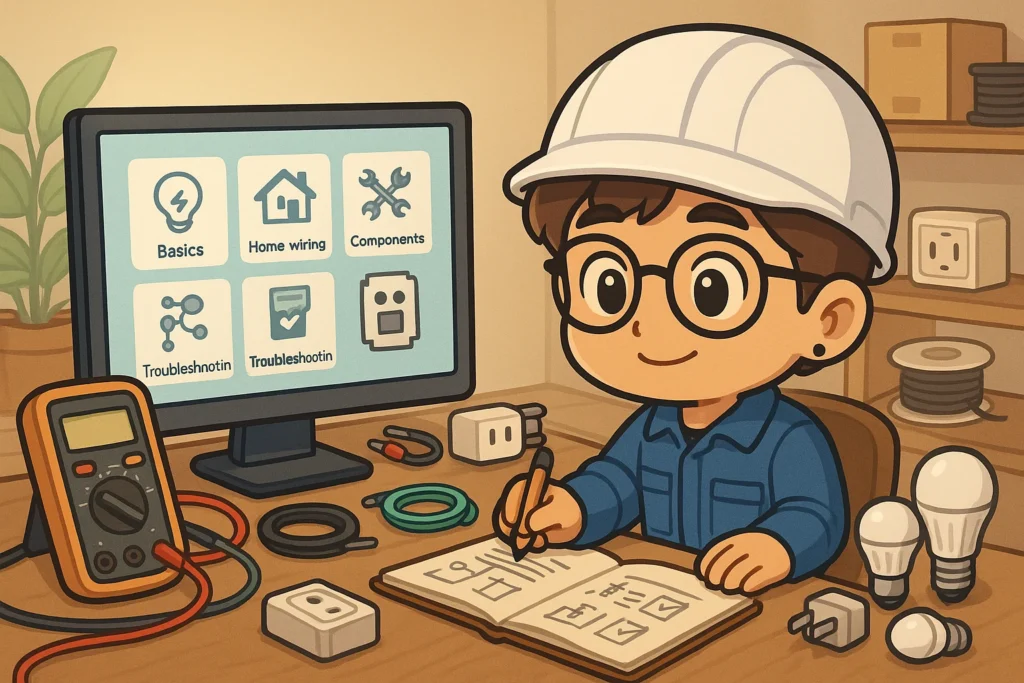
About this Electrical Guides Library
This page is your index for all electrical guides on Tsai Electro. Moreover, you can search and filter tutorials covering basics, home wiring, components, safety and troubleshooting. Because each guide keeps theory short and focuses on steps, diagrams and checklists, you learn faster. As a result, you can move from reading to doing with less guesswork.
Topics These Electrical Guides Cover
Electrical fundamentals · Ohm’s law · AC/DC basics · Home wiring and outlets · Protective devices and relays · Meters and safe measurement · Components and LED drivers · Troubleshooting common faults and practical fixes.
How to Use These Electrical Guides
- First, use the search box or category pills to find a topic.
- Next, open one guide and complete a single task with the checklist.
- Finally, save the tools and diagrams linked inside each article for later jobs.
FAQ
Where should beginners start?
For beginners, start with Tutorials, then the “Electrical Basics” path; after that, move to wiring and safety.
Are these tutorials safe for DIY?
Yes, but always follow safety notes; if unsure, consult a licensed professional.
What tools do I need?
Typically, a non-contact tester, a multimeter, insulated screwdrivers and proper PPE are enough.
What’s the difference between Articles and Tutorials?
In short, Tutorials are step-by-step lessons, whereas Articles are quick reads for specific topics.
Can I use these guides for my home wiring?
However, codes differ by region; therefore, always follow your local electrical code.
Popular paths: