These Electrical Guides turn core electrical concepts into short, field-tested lessons with diagrams and checklists. Start with the basics, then follow a learning path for home wiring, safety, and components. Each Electrical Guide ends with a quick task, a tool list, and a study map so you can practice today and return later with confidence.
First, search a topic. Then, pick one guide and finish a quick task. Afterward, use the checklist to confirm the result. Additionally, each article links to tools and study maps, so you can learn fast and act with confidence.
To start, browse the latest posts. Then, pick one guide and try a single task. Afterward, use the checklist to confirm the result. In addition, each article links to tools and study maps, so you can learn and act with confidence.
All articles
-
NEC 424 and 426 for Apprentices: Baseboard Heaters, the 125% Rule, Heater Disconnects and Snow-Melting Cable
How the NEC treats fixed electric space heating and outdoor deicing equipment: sizing the branch circuit at 125%, baseboard heaters and receptacles,…
-
NEC 408 Panelboards for Apprentices: Circuit Directories, Overcurrent Protection, Backfed Breakers and the High Leg
What Article 408 asks of panelboards and switchboards: a clear circuit directory, source marking, overcurrent protection for the panel, backfed breaker fasteners,…
-
NEC 392 Cable Trays for Apprentices: Tray Types, What Can Go in a Tray, Fill for Large Cables and Bonding
What Article 392 says about cable trays: ladder, ventilated and solid bottom trays, which wiring methods are allowed, installing the tray as…
-
NEC 225 for Apprentices: Feeding a Detached Garage or Second Building, Disconnects, Four-Wire Feeders and Grounding
How Article 225 treats a feeder to a detached garage, shop or second building: one supply per building, the disconnect at the…
-
Texas First-Year Apprentice Electrician: The License, Supervision, Hours and the Skills to Learn in Year One
What year one looks like for a Texas electrical apprentice: the TDLR apprentice license and its $20 fee, who supervises you, how…
-
NEC 600, 620 and 670 for Apprentices: Sign Circuits, Elevator Disconnects and Industrial Machinery Supply Conductors
What the NEC adds for electric signs, elevators and industrial machinery: the sign outlet at each tenant entrance, sign disconnects, elevator disconnects…
-
NEC 500 Hazardous Locations for Apprentices: Classes, Divisions, Groups, Temperature Codes and Conduit Seals
How to read a hazardous location: Class I, II and III, Division 1 and 2, gas and dust groups, Zone classifications, temperature…
-
NEC 445 Generators for Apprentices: Conductor Sizing at 115%, Disconnects, Portable GFCI and Standby Transfer Equipment
How the NEC treats generators: sizing conductors from the generator terminals at 115% of nameplate current, the disconnect, GFCI on portable generator…
-
NM Cable, MC Cable and Flexible Cords for Apprentices: NEC 334, 330 and 400 Support, Bends, Ampacity and Cord Limits
How to install NM and MC cable and when flexible cord is allowed: support spacing, bend radius, the 60°C ampacity limit on…
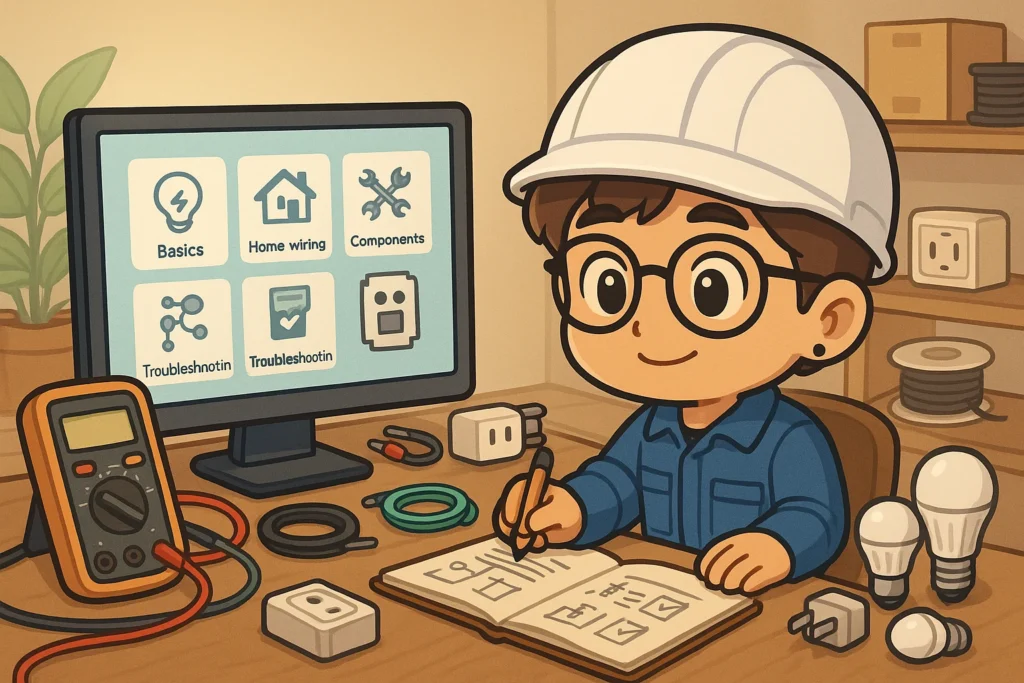
About this Electrical Guides Library
This page is your index for all electrical guides on Tsai Electro. Moreover, you can search and filter tutorials covering basics, home wiring, components, safety and troubleshooting. Because each guide keeps theory short and focuses on steps, diagrams and checklists, you learn faster. As a result, you can move from reading to doing with less guesswork.
Topics These Electrical Guides Cover
Electrical fundamentals · Ohm’s law · AC/DC basics · Home wiring and outlets · Protective devices and relays · Meters and safe measurement · Components and LED drivers · Troubleshooting common faults and practical fixes.
How to Use These Electrical Guides
- First, use the search box or category pills to find a topic.
- Next, open one guide and complete a single task with the checklist.
- Finally, save the tools and diagrams linked inside each article for later jobs.
FAQ
Where should beginners start?
For beginners, start with Tutorials, then the “Electrical Basics” path; after that, move to wiring and safety.
Are these tutorials safe for DIY?
Yes, but always follow safety notes; if unsure, consult a licensed professional.
What tools do I need?
Typically, a non-contact tester, a multimeter, insulated screwdrivers and proper PPE are enough.
What’s the difference between Articles and Tutorials?
In short, Tutorials are step-by-step lessons, whereas Articles are quick reads for specific topics.
Can I use these guides for my home wiring?
However, codes differ by region; therefore, always follow your local electrical code.
Popular paths: